Saturday, October 6, 2012

Thinking Flexibly, Subtraction Problems

Subtraction Strategies

Thinking flexibly about numbers is one of our goals for students in third grade. We’ve been highlighting multiple strategies in Closing Session as we teach students that subtraction is the distance between two numbers. We do this to highlight students' use of an efficient strategies, and as a springboard to challenge students to attempt a strategy that they may not have mastered.  Students quickly realize that some of the strategies are more efficient for particular situations and less prone to computational errors.

Students, as we conclude our subtraction unit,  should be comfortable with multiple subtraction strategies. Solving a problem in using two strategies prevents a computational error that may have been overlooked. Our goal is to have students who can recognize, based on the situation, the most efficient strategy with the least likelihood of error, and with the idea that mental math can be one of the most effective ways to solve.  

For example, we don’t want students to use the traditional algorithm to solve an equation like 1000-989=m, because it would be easy for them to make a computational error when regrouping multiple times. Rather, we want students to recognize that the distance between these two numbers can easily be done by counting up, 989+1=990 and 990+10=1000,therefore, the difference is 11. 

Of course, in other situations, it's simply easier to solve using the traditional algorithm. In 876-563, the quickest way to the difference is simply using the traditional algorithm. 

In order to develop number flexibility, we’ve been working on several strategies in class.
Sample Problem:  245 - 178 = m
Adding up
Turn the equation into a missing addend 178 + m = 245. Put the number 178 on a number line and count up to the next landmark number. (Landmark numbers have a O or 5 in the ones place.) 178 count up 2 to 180, count up 20 to 200, and then jump 45 from 200 to 245. Adding the jumps gives you the answer, m = 67.

Decomposing
Decompose the number by place value, then subtract each place value. In this problem, 200-100 = 100, 40-70 = -30, 5-8 = -3, therefore 100-30-3= 67.  Sometimes, this strategy has you in negative numbers, but students know that 0 is the middle of the number system and can flexibly use negative numbers. Some students use this strategy and regroup from the larger place value. If they did that in this problem, they would take a group of 100 from 200 and put 140 in the tens place.

            245  :     200  +   40  +   5
          -178  :    -100  +   70  +   8
                            100   - 30  - 3 = 67

Counting backward
245 - 178 = m                                                                    

Put 245 on the open number line and count backward 178. You can make the jump of 178 any way you want. Most kids jump backward to landmark numbers. 245 jump back 45 is 100, and then jump back 30 is 70, then jump back 3 is 67. This strategy works best for students who can readily count backward, other students find it difficult.
Left to Right 
Students think 200 – 100 = 100 and 40 – 70 = -30 and 5 – 8 = -3.  Then, 100-30 is 70, and 70-3 is 67.
            245  :    
          -178  :   
            100 – 30 – 3
                70 – 3 = 67

 Compensation / Creating an Equivalent Problem
In some situations, we also encourage students to compensate to create an easier equivalent problem. Generally, in subtraction, when you create an equivalent problem your goal is to create a problem where regrouping is not necessary. Many students try to create the digit 9 in their minuend.

For example,
  56   + 3        59
-47     -3       -44
                        15

Remember, the purpose of exposing students to multiple strategies is two-fold. First, students need to be able to solve using two different strategies to check their work, and secondly students will be able to identify the strategy that is most efficient based on the problem. Students who successfully accomplish this have number sense and are able to work with numbers mentally and flexibly. Our students are busy every day becoming young mathematicians.

Math Portfolio Piece, Addition Strategies

Addition Strategies

From time to time, we have students complete math portfolio pieces to show evidence of students' understanding of a concept or skill. Recently, students completed an addition strategy piece. 

The portfolio piece had two problems, 298+574, and a word problem, Mrs. Shall has 321 shells in her seashell collection. Miss Russell has 524 shells in her seashell collection. How many seashells do Mrs. Shall and Miss Russell have if they combine their collections?

Students used two different strategies to solve. Research shows that when students make a computational error and use the same strategy the second time they solve, they commonly make the same mistake. In addition, students with a tool box of strategies are better able to approach each problem and use the strategy that is most efficient for the given problem. 

In some situations, the most efficient strategy is the traditional algorithm, but in others, to use more mental math, it may be compensation or left to right addition. 


This is a student's sample from our Addition Portfolio Piece. You'll notice that the student used two different strategies to solve 298+574, decomposing by place value and left to right addition.

Decomposing By Place Value
298+574
(200+500) + (90+70) + (8+4)
      700        +    160      +   12     =   872

Decomposing by place value is a strategy used by many mathematicians for mental math. The strategy keeps the place value of the numbers, and gives students the opportunity to solve for partial sums by place value.  The strategy, in this situation, avoided the traditional regrouping between place values. You can see the student's understanding of correct algebraic notation, too.

Left to Right Addition
     298
   +574
     700
+  160 
       12
    872

Like decomposing, left to right is a strategy that lends itself to mental math, and keeps the place value of numbers in perspective. You'll notice the student's partial sums are recorded by place value, too.  Again, the student has avoided the traditional strategy of regrouping that the traditional algorithm demands in this equation.


Compensation / Creating an Equivalent Problem
In the second problem, the student also shows his command of at third strategy, compensation. He solves 321+524 by creating an equivalent problem, 321+524 = 330+ 515.

    321  (+9)   330
+ 524  (-9)    515
                       845

When compensating, students create an equivalent problem using landmark numbers. Students can easily solve 330+515 without pencil and paper.  

Many of the students on this portfolio piece used compensating for the first problem, too, 298+574.   Compensating to create the equivalent problem 300+572 makes solving the problem so much easier. This type of flexibility in thinking is exactly what adults with good number sense do on a daily basis.

     298  (+2)  300
 + 574   (-2)   572
                        872

Traditional Algorithm
We don't avoid the traditional algorithm, but we do insist that students correctly explain it when they solve. In the second problem many students used the traditional algorithm.   This strategy was very efficient because it did not require any regrouping.  
    321
+  524
    845


A few students used the traditional algorithm for the first problem which did require regrouping. 
      11 
      298
   +574
      872

When using this strategy students should be able to explain, "Eight plus four equals 12, I regroup 10 ones and create another group of ten. One group of ten, plus 9 groups of ten, plus seven groups of ten equals 18 groups of ten. I make one group of 100 out of 10 groups of 10.  One group of 100, plus 2 groups of 100, plus 5 groups of 100, equals 8 groups of 100. My sum is 872."    

Students reach this level of abstract math understanding by first exploring other strategies. One of the earliest strategies students explore is the open number line.


Open Number Line

The open number line is a concrete strategy that third grade students commonly revert to, particularly when they get stuck, or have conflicting sums in two different strategies.   When using the open number line, we encourage students to start with the largest addend and then add on.  We also encourage them to make the fewest jumps possible. One way of jumping on the open number line is provided in this example. 


Regardless of a student's strategy, we are working toward efficiency, flexibility, and good number sense. We know that exposing them to many strategies will assist them in reaching this goal. 

Monday, August 27, 2012

Group Jobs

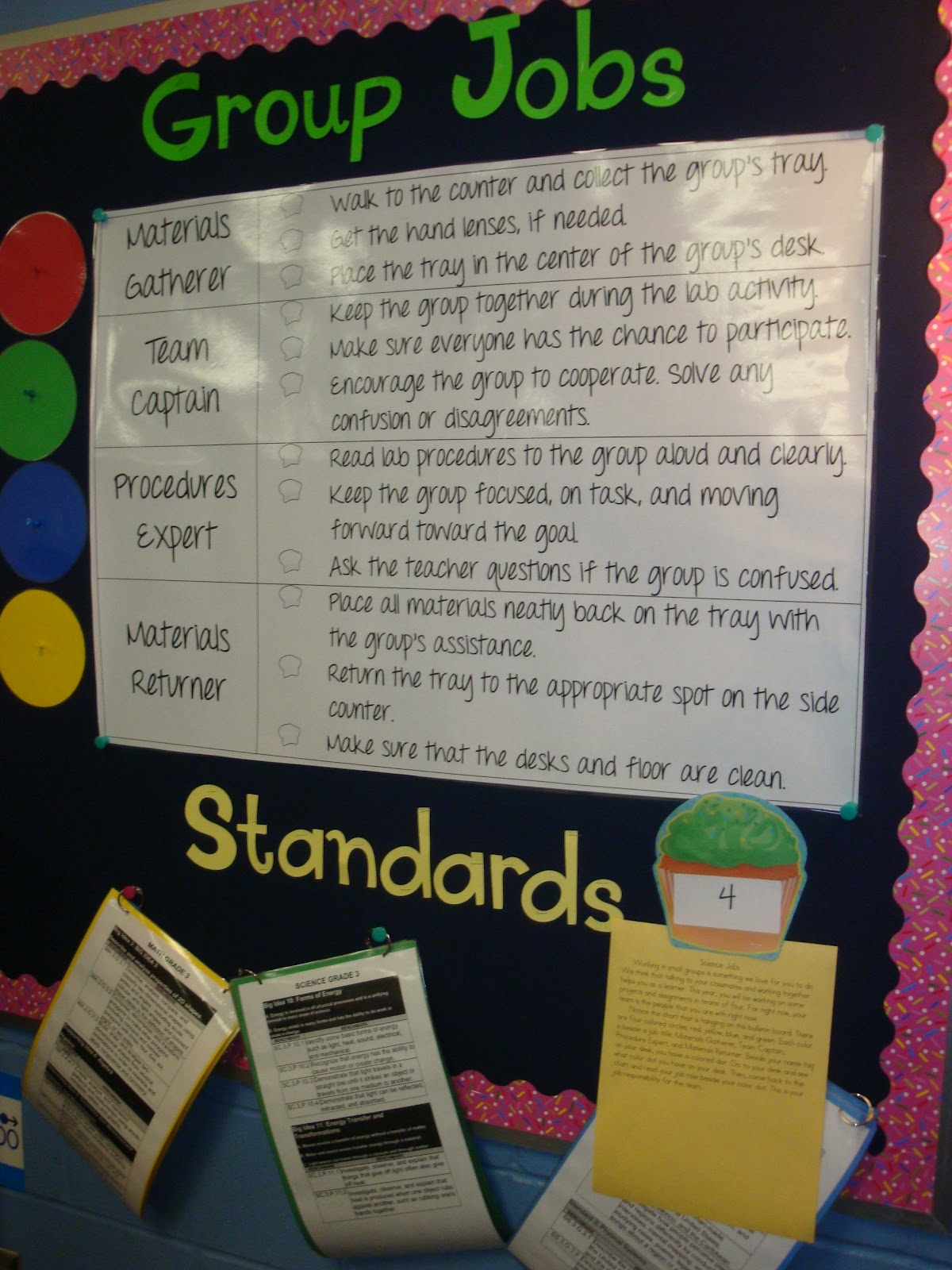
To facilitate classroom movement and efficiency during small group work, and to grow independent learners, we have group jobs in our third grade classroom. We have four jobs because four students sit at each table group, giving each student a participatory role. Jobs include Materials Gatherer, Team Captain, Procedures Expert, and Materials Returner. 


You'll notice the colored dot in front of each job on the Group Jobs bulletin board. This laminated colored dot is pinned to the board so we can swap jobs often by simply moving the colored dot to a different job role. One day a green dot may mean the student is the Team Captain and the next day, the green dot may mean that the student is the Procedures Expert. On each student's desk, we have a colored dot. On the student's name tag in the picture, you'll see that the student has a yellow dot. The job role for the day for that student is Materials Returner. 


On our side counter, we have twelve trays set up. The teacher places the day's materials, handouts etc... on each of the trays. The Materials Gatherer picks up the tray and takes it back to the table before we start a task. The Team Captain makes sure that the group is working together on the task and that everyone has an opportunity to contribute to the groups conversation and task. The Procedures Expert reads lab procedures, moves the group toward the goal, and asks the teacher a question if the group gets confused. When the task is complete, the Materials Returner is responsible to ensure the area is clean and the tray is returned to the correct table group side tray. 


We've loved this classroom organizational tool because it saves valuable instructional time and gives everyone purpose during each task. If you try it, we hope you love it, too!


Friday, August 24, 2012

Organizing Our Anchor Charts

We create Anchor Charts of student learning frequently in our classroom, particularly in our Closing Sessions. Sometimes these anchor charts are a "sloppy copy" completed during the Workshop and meant only to post in the classroom for a short period of time. 

However, on other occasions, we spend time after we've created a Closing Session "sloppy copy" with the students to make a polished chart that will hang for the entire unit, because it's a chart that students will have to reference often.  You can see one of those charts, Strategies for Comparing Fractions, hanging on our Math Anchor Chart wall.  I want to reiterate that these charts are never hung until after the Workshop and the "sloppy copy" is made with students.  Some of the charts, that take extra time to create, we laminate and use from year to year.

This year, we decided to be more organized with our charts. A colleague shared her strategy and we loved it. We purchased some pant hangers from Target that have an add on  loop at the bottom of each hanger. The hangers hold a chart and you can add the next hanger on the add on loop. The beauty of the system comes from the easily made stacks and we LOVE the fact that we can see the title of each chart. We  took it one step further and hung the charts by subject and unit for easy accessibility. The display you see below hangs neatly in our closet. We hope you love the idea as much as we do!


Classroom Centers to Roll Out Rituals and Routines

Like all teachers, my co-teacher and I spent time preparing and organizing our classroom for the arrival of new students this school year. We set the room up strategically as we thought through our systems. Making sure the learning community was set up to promote the growth of independent self-directed learners was our priority. Explaining these systems to students and our expectations was necessary but we wanted to strike the perfect balance between telling and allowing them to explore during those first few days of school. 

We decided to cover a few of the essentials that students always ask like,  When are we going to lunch? When is recess? Where is the bathroom? Beyond that, we decided to let the students do some exploring. Nine stations were set up throughout the classroom to cover and explain elements like 1) Lost and Found & PTA Bins   2) Recess materials   3) Math Games and Manipulatives   4) Science Jobs   5) Tray Material Retrieval   6) Materials Bins   7) Class Bank and Store   8)  Research Library   9) Laptops and CPS Clickers. An explanation was hung with each station number and students in groups of three to four visited each station. 

Embedded within the explanation were questions for the students to answer, and a few of the stations had a couple fun activities like voting on a name for our classroom fish and guessing the number of cookies in a jar. 

We broke the stations into two different segments during the day, so it wasn't too much reading for the students, and when we finished, we quizzed the kids on the material and handed out skittles for correct answers. It really was a great way to cover some of our rituals and routines without having to bore the kids with too much talking. We will certainly do it again next year, and might even add a student recording sheet to help with student participation and accountability. 


Classroom Blogging

Parents, particularly working parents, seldom have the time or luxury to visit the classroom on a consistent basis. I've found that they want to be involved but simply need a way.
Classroom blogging is an easy way to post pictures, write about experiences, and share a glimpse into student's learning. It isn't elaborate but it's a way to connect parents and we've found that they deeply appreciate the gesture.  To check out our third grade classroom blog, visit us at our 5 Star blog.  To visit two of my colleague's first grade classroom blogs visit them at their Sweet Shoppe and at Mallards Marvelous Menu. 

Wednesday, August 22, 2012

Days of School

180. Most every student and teacher knows the number of days in the year, and in classrooms throughout our nation Day 1, Day 100, and Day 180 are the most celebrated. It's not uncommon for the number of days to be recorded as a visual reminder of where we've started, how far we've come, and when we've reached our final destination.  In fact, the number of days we've been in school has been integrated into many Math Skills Block programs including the one that is conducted in my classroom. 

This year, my co-teacher and I borrowed this idea from a colleague. On a piece of 8 1/2 by 11 card stock, we made a place value chart of hundreds, tens, and ones. We laminated the paper, hole punched a set of digit cards, attached a metal ring, and placed them on large push pins to the hundreds, tens, and ones. Of course, for our purpose, we only needed a O and 1 on the digit cards in the hundreds place.   

We put the Days of School chart right below our Calendar and right above our Counting Tape. We'll track the days of the school year on our new flip chart, and then we will also add the day to our Counting Tape. You can see that our Counting Tape has been set up below our board into three rows of 60 with space between each row. We keep the Counting Tape, too, because we use colored dots to count by twos, threes, fours, etc... as we add the number of days we've been in school. By the end of third grade, students will be seeing many patterns among the multiples of numbers.  We'll include questions into our Skills Block like, How many days have we been in school?  How many more days until our field trip? How many more days until we celebrate Day 100? How many more days until the last day of school? What day of school will be ten more than 60? How do you know?

Hope you like the idea as much as we did!  Good luck as you embark on this year's 180.