Tuesday, January 25, 2011

Fuel Up to Play 60 with Mojo!

To a cheering student audience, Jacksonville Jaguar player, Maurice Jones-Drew took the stage. He was at Chets Creek today to speak to third, fourth, and fifth grade students about a special program, Fuel Up to Play 60 which emphasizes healthy eating and sixty minutes of physical activity every day. A grant written by our P.E. Coaches, Estrella Bailey and Ray Robinson funded the memorable assembly which will surely be a highlight of the kids' school year.

Jones-Drew not only spoke to the kids but eagerly answered oodles of questions. Just a few of the questions our students wanted to know:
What are your favorite foods? How much time do you spend working out during the season? What do you feel like in the five minutes before you take the field? What does it feel like to score a touchdown? Who do you think will win this year's Superbowl? Who is your favorite college team? Who is your biggest opponent?

My son took the stage to ask, "Who was your childhood hero?" to which Mojo answered, "My grandfather." Later my son remembered being told that Maurice's name was Maurice Drew, but in college while playing in the Rose Bowl, Maurice's grandfather died of a heart attack. In tribute to his grandfather he added his grandfather's surname, Jones, to his own name becoming Maurice Jones-Drew. What a great lesson for my young son to learn about honoring your lifelong heroes.

In the final minutes, our Principal, Susan Phillips asked, "What was your favorite subject in school?" Of course, he got a round of applause when he answered, "I am a mathematician!"

Here's to you Maurice, for not only sending the stay fit and healthy message, but also for reminding students to continually work toward their goals because anything is possible.

Friday, January 21, 2011

Purple Cow Standards Board of the Month

When you walk into our building, it's clear that we have a strong academic focus. Almost everywhere you look you see celebrations of student achievement, and unlike the holiday themed bulletin boards of yesteryear, our bulletin boards display student work samples with teacher commentary. Classroom instruction becomes transparent because of this visibility of student performance in reading, writing, math, science and social studies. Our only regret is that we've had no way of cataloging and keeping the boards for future reference, until now.

With nearly 50 bulletin boards at CCE, there is no feasible way to digitally warehouse all of them, so we've started by capturing two a month, one primary and one intermediate. After the new boards go up, teachers submit Purple Cow nominations for their colleagues' boards. A team gets together to read all nominated boards and selects one intermediate and one primary board that stands out above all the rest. The competition is steep because the boards are so creative and well done, but usually the Purple Cow is chosen because it presents a new idea that others may want to implement in their classroom or does an exceptional job capturing a moment of time in their classroom.

It's unlikely that every teacher will have the opportunity to read every board each month, but with the Purple Cow highlighted, we are hoping that every teacher will at least read the two Purple Cow Boards that can't be missed. So far, the idea has caught on and one teacher even teases that she's wearing her Purple Cow ribbon in her hair!

I'd love for you to visit our Standards Based Bulletin Board blog created and maintained by our Tech Coach, Melanie Holtsman, to read our highlighted boards. You'll see the start of what we hope will become a long tradition. Make sure you click on pictures to enlarge and print the items. I'd love to hear your comments. Stay tuned for more...

Sunday, January 16, 2011

Academic Family Nights

Several times a year, we hold academic Family Nights to communicate grade level expectations with parents and answer frequently asked questions. Earlier in the year, Second grade teachers held a 2nd Grade Math Night, and this week Third grade teachers hosted an FCAT Reading and Math Information session while Fourth grade teachers held their FCAT Writes Night.

The session topics are selected with that grade level’s specific needs in mind. Typically, 2nd grade parents have many questions about the transition in math. They are curious about how math is being taught conceptually and what that means in reference to skill based teaching. They also want to know if their child will learn the standard algorithm for addition and subtraction the way they did. We begin the conversation with an overview of the three prongs of math—concepts, skills, and problem solving and explain how we use our math resources of Math Investigations, Every Day Math Counts, and Envisions to meet grade level Sunshine State Standards while teaching within each of the three prongs. Then, our teachers concentrate on explaining the strategies of addition and subtraction so parents have a better understanding of how we are teaching number sense and flexibility of thought. The session wraps with an open floor so all parents leave with their questions answered.
Third grade parents are always full of questions about FCAT and its implications. 3rd grade is the first year that students take the state standardized test in Reading and Math so this session is often packed with curious parents. The Third grade teachers provide an overview of the many facets of FCAT as well as show parents some sample problems. In addition, they discuss the embedded ways we are preparing students, like spiraling homework and formative assessments, and we clarify how we don’t stop teaching at any point for FCAT prep. Sharing strategies that parents can implement at home to help their child is a part of this gathering. Again, the evening ends with a questions and answers session.

Fourth grade parents are old hats at FCAT so just when those questions dissipate, they are curious about the state writing test. What do students have to score? What does meeting the standard look like? How are you preparing students for success on the test? How is a prompt different from the Writers’ Workshop? Is my child going to do well? These questions drive the evening’s conversation. In addition, teachers hold a fish bowl mini Writers’ Workshop with students to give parents a bird’s eye view of what is happening to prepare students in the classroom. Explaining the logistics of the 45 minute prompt write is something new to parents, and we hope they walk away feeling good about what we are doing to prepare their child. Teachers field questions as the session concludes.

Nights like these provide the platform for a deeper parent understanding of our curriculum, standards, and state assessment expectations. We hope that they leave with peace of mind and comfort in knowing that we thoughtfully and strategically prepare their students not only for the state assessment but for their future.

Tuesday, December 14, 2010

Word Walls

What is the first thing that pops into your head when I say--word wall? Did you envision a list of high frequency words assembled neatly under their beginning letter on a long abc...xyz chart in a classroom?

That is actually the most typical visualization, however it is only one type of word wall. The mental image you created of a spelling word wall is the most common word wall tool in the primary school used as a visual reference for students of high frequency words. The spelling word wall is used to support the growing number of words students should be able to read and spell correctly. They are introduced gradually with explicit instruction before being added to the wall. When done well, activities are built around the word wall offering extended exposure and chances for repeated practice are consistent until the words are mastered with great efficiency. The other type of spelling wall I envision is one centered around spelling patterns... -at, -ike, -ake, etc... Below are examples of some of the spelling word walls displayed and used in classrooms at Chets Creek.

Spelling Word Walls


A second type of word wall you would encounter in our classrooms is a writing word wall. Most commonly, our writing word walls are displayed as a tool for students to use during their Writers' Workshop to enhance the level of vocabulary used while writing stories. The typical writing word wall includes simple words, like said, that can be replaced with more descriptive or sophisticated terms, like squealed or whispered. In addition, as children learn about sentence structure and offering sentence variety in their writing, they might find useful words displayed by part of speech. On several occasions, I've also seen students with independent word walls on the back of their writing folders. These words are individualized and typically words most often misspelled in that student's writing. The personal word wall is used throughout the writing process.


Writing Word Walls


Reading Vocabulary is another universal word wall used in CCE classrooms. In Kindergarten through Third Grade, we use Scholastic's Text Talk series for explicit vocabulary instruction through children's literature read alouds. Several words per book are introduced with explicit instruction and activities using the words are taught. Furthermore, you will find reading vocabulary word walls that are built as students are introduced to words in the context of other reading. For example, one of the word walls below is from the chapter book, Because of Winn Dixie.

Reading Vocabulary Word Walls


Content Vocabulary Word Walls in Math, Science, and Social Studies are frequently displayed in CCE classrooms in K-Grade 5, too. Just like spelling, writing, and reading vocabulary word walls, content word walls are used not only as a display but as a reference tool, too. The primary goal is for student mastery and understanding of each of the terms. Some content word walls have the definition displayed with the word on the front of a card, others have the term printed on the back and are secured with velcro to a chart or stored inside a pocket chart making them easily removable by students. Also, other displays are a list of the words that teachers use for specific activities. You can see a few examples of each type below.

Math Word Walls


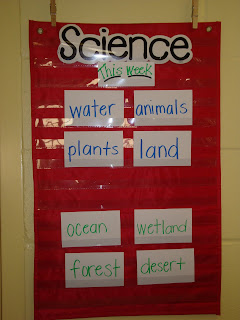
Science Word Walls


Social Studies Word Walls


Print rich classrooms full of resources including word walls are important to promote student learning and achievement. Word walls make words visible, usable, and accessible to our learners. I'd love to get a comment about the way you use word walls in your own classroom.

Tuesday, December 7, 2010

Reflective Conversations

The world of a coach, just like a teacher, gets busy on the first day of school and never slows down. "Is this your busy time of the year?" Is a question that always bewilders me, because truth be told, all 196 teacher days are a busy time of year. Something, I've come to believe only an educator can fully appreciate. Boarding a Lear jet on the first day of school depicts the typical momentum that begins on Day 1 and ends when the last bell has rung, the classroom is packed up, and we emerge on the other side for a blissful few uninterrupted weeks. Until, once again, the planning begins for the upcoming year, if it truly ever ended in the first place.

Hurling at mock speed, we often forget that a critical component of growing professionally is to reflect on our practice. Where have we been? Where are we going? Questions like these allow you to reflect, refocus, redefine, and reembrace your work. The answers certainly aren't fancy but get at the heart of strategic planning. For me, this type of reflection comes easily now, but in my early teaching years, it took a leader asking me these questions and listening attentively as I answered them.

This year, I'm trying this reflective practice with our new teachers. Each of them is meeting with me this week to answer these questions:
  • What are you most proud that you've accomplished so far this year?

  • What would you like to work on as you move into the second half of the year?

  • What do you need for me to do for you?
The reason for the conversations are two fold. First, I want new teachers to get in the habit of reflecting and second, I want to know, from their point of view, what they need to learn next. Each conversation has been intriguing. I've learned from them about their professional celebrations and their needs. The dialogue has captured a plan for me to move forward in supporting them. As we move into the new year, I'll be gathering some important content resources, setting up a couple of observations, demoing a few lessons, watching and giving written feedback, and teaching about wikis and Gizmos to name just a few things. What I like most about this process is that I am really getting to know each teacher better and I feel like I'll be able to meet their specific needs. This is definitely a practice I'll continue in the future. Stay tuned...

Saturday, November 27, 2010

Math Anchor Charts

My last post described the anchor chart as a learning tool in classrooms across our school. I highlighted snapshots I took based on our reading instruction. I thought you might also like a glimpse into our anchor charts in mathematics.

Some math anchors are displayed to help students conceptually understand and remember mathematical vocabulary.


Others remind students to think about their noticings or connections as they pertain to specific lessons including math games.


Anchor charts also highlight foundational learning like finding combinations of numbers. A students ability to decompose a number is critical for developing number sense and flexibility when solving problems. Many mental math strategies come back to a student's ability to decompose numbers efficiently. In addition to combinations, students also work with doubles and near doubles as they build number sense. Often times, you will find charts like these hanging in our primary classrooms.


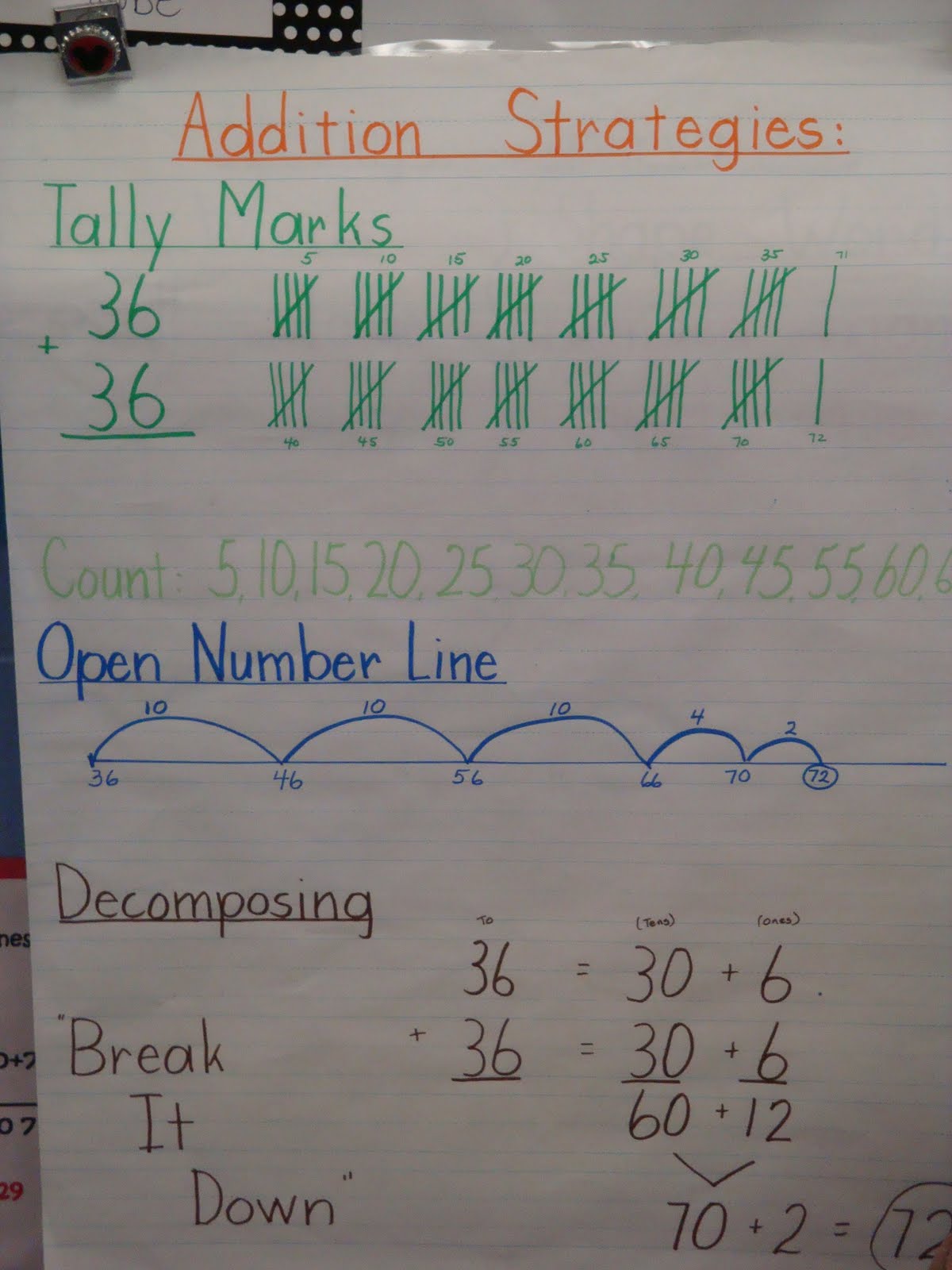
Furthermore, strategy charts play a prominent role. They are not charts that are premade and hung before instruction, rather are anchors built with students as new strategies emerge. Some charts show single strategies while others display many strategies.
Often times, when the chart lists more than one strategy, the strategies are listed by order of efficiency. The visual reminder helps students as they move along their learning pathway. In this case, a student's work may also become an anchor chart on the classroom wall as a reminder of a particular strategy that has been highlighted in a classroom math discussion.


We use Math Investigations as our 60 minute Math Workshop curriculum tool. Like many conceptually based programs, MI embeds story problems into many of their math lessons. Therefore, it is common for teachers to have anchor charts which guide a student through solving a problem. Sometimes the anchors are found on a student's desk, some are in their math journals, and others hang on the classroom walls.


Still other math anchors assist in building student knowledge throughout units of study or remind students of necessary skills like multiplication and division notations.

Regardless of their content, all math anchor charts have the same intent-to be a visual reminder to students of the thinking that has taken place and to act as a springboard for further learning. Classrooms displaying rich math anchor charts offer students the environment they need to become effective mathematicians.