Showing posts with label Math. Show all posts

Saturday, September 13, 2014

Math Council Meeting #1

Math Council met for our first meeting of the 2014-2015 school year on Wednesday. Our agenda was packed because of all the changes this year. We have new standards, new content limits, new item specifications, and new state standardized assessments. We also have new online tools purchased by the district.


Knowing what we do about S-C-I-A (Standards, Curriculum, Instruction, and Assessment) alignment, we know that new standards and the definition of how we assess them, changes everything. It changes the curriculum units we use as teacher tools, the instructional content we teach, the rigor and depth of the questioning we use, the level of tiered instruction we'll implement, the assessment questions we create, and the homework we give. It basically turns back the clock of time.

We start all agendas with a quote; It seemed fitting that I used, "In places where most people see challenges, Julie Jackson sees opportunity and promise." from a new text I'm reading, Leverage Leadership.  At The Creek we've always seen challenges as opportunities. Though we will be turning to new, we know that with the new, often brings growth. It'll be hard work but in the end will lead students to a deeper math understanding.  As professionals it will require us to study and hone our craft, but we are ready and willing.

The agenda was structured around four questions, Where Have We Been, Where Are We Going, How Will We Get There, and What Do We Need to Get There? 

Where Have We Been?:  We quickly analyzed last year's data to give us a clear picture of what we had accomplished and what next steps remained.  Due to all the changes, we didn't spend time setting new goals based on this data, rather will closely monitor our exit tickets and common aligned assessments as we move forward this year.

Where Are We Going?:  The majority of our time together was spent on discussion about our new standards and the new state assessment. To begin, council members paired up and took a true/false quiz on the new Grade 3 standards that was written by our third grade math lead, Ashley Russell. The team answered the questions to the best of their ability and then logged on to http://flstandards.org to look up answers. After they looked up a few, Ashley provided an answer key with notes. Here is a partial part of that quiz:    

Grade 3 Mathematical Florida Standards

Use multiplication and division within 100. 
TRUE         FALSE
Notes
Understand the Associative Property of Multiplication.
TRUE         FALSE

By the end of Grade 3, students will know from memory all products through 12 x 12.
TRUE         FALSE
through 9x9
Solve one-step word problems using the four operations.
TRUE         FALSE
two-step
Use place value understanding to round whole numbers to the nearest 10 and 100 only.
TRUE         FALSE


The leads found the exercise interactive and beneficial with getting acquainted with the standards and saw the benefit in clearing up misconceptions. As they create their own standards quiz for their grade level, I've asked them to share a copy with me. Having a vertical picture of the math standards is one goal of the Math Council team.

"Standards are meaningless until you define how to assess them." Another quote taken from Leverage Leadership which created the springboard for our next activity. We logged on to the Florida Assessments Training Test at http://www.fsassessments.org and took a Training Test. (Open in Firefox, Click on Students/Parents, Click on Training Test, Click on Sign In as Guest User, and Start Test).

Right away, our leads recognized the depth of change. Students would have to get really comfortable with technology tools, varying question stems, answering with multiple correct answers rather than just choosing a best answer. A deeper level of content understanding and number sense would be necessary. The list goes on and on. The Training Test shows the rigor at which the state plans to assess.


How Will We Get There?:  I put together binders for each lead with the grade level standards, the content to be covered on their grade level test, and the sample item specifications of new questions and stems. We turned our attention for a few minutes to these documents that will need to be dissected in order for full understanding and to give leads the ability needed to begin making changes to the assessment questions on their common aligned grade level assessments, exit tickets, and homework. This is where the depth of our time, energy, and expertise will be needed this year to begin the massive revisions.

Again, I used Leverage Leadership by reviewing Chapter 1 on Instruction, highlighting major points, to give leads an understanding of why we need these revisions to be common, state assessment aligned, and curriculum aligned. It will be a difficult and time consuming, but we have to find a way.

Our discussion in this area also included the importance of teachers following the Learning Schedule. Only when learning schedules are followed can common aligned assessment occur for grade level discussion of student work and assessment results. The level of rigor needed must be embraced across all classrooms on a grade level. We plan on much more sharing of student work during Teacher Meetings to make this a reality.

What Do We Need To Get There?:  With a change in standards, comes changes in content. Some of the new standards will mean rearranging curriculum units between grade levels, others will require buying new materials, and yet others will mean that we need professional development in certain areas. We know, we will need inch rulers in first grade, Number Talk books in K/1, and we will need to send leads to the Florida Math Conference. I'm sure there are other needs, too, that will emerge, and this team stands ready to fulfill the requests.

We also recognize that new ideas will be implemented and old ideas tweaked to better meet the needs of all students. Though, I called these Tidbits on this month's agenda, as we move forward I'll call them Small Gems. Two small gems from this meeting included Ashley's implementation of a Today's Number Sheet during her math center teacher led group, and Angela's implementation of her common board configuration and lesson planning. They were ideas that were shared so others, seeing connections, may immediately implement.

If you are interested in reading more about our Math Council meetings, stay tuned... We met, again, on October 8th! 


Friday, April 29, 2011

Exit Tickets

As math educators, we must make broad judgments daily about whether the class understood the day’s lesson before we move on with instruction the next day. The pulse of the class is taken easily because of the level of student interaction and discussion during the questioning segment of the lesson, but it’s harder to get a clear picture of what individual students have mastered and are able to do independently. Though whole group instruction may move forward the next day, it is our responsibility to ensure that all students are reaching mastery. We need to know specifically students who need small group reteaching or more support for success. Because, at CCE we are aware that retention rates for students are highest when they teach others (90%), practice by doing (75%), and partake in discussion groups (50%), many days my students are working in pairs or small groups in math. There is not always the opportunity to collect independent student work, so we needed another teaching strategy to accomplish the goal of knowing whether every student was at mastery on the day’s work.

Exit Tickets have become our answer. An Exit Ticket is a formative teaching strategy given immediately after the Math Workshop concludes which focuses students on the core content of a lesson and promotes a quick and independent assessment check. Each student answers a question or two that targets the big idea for the day. The checkpoint, taking only a few minutes, offers teachers the immediate opportunity to check students’ independent mastery of the day’s content.


Exit Tickets are simple and time efficient to create and analyze. When preparing for a lesson the teacher has to think, “If I teach this math concept or skill effectively, which question should students be able to answer at the end of the lesson?” This question or two should align with the big idea.


Typically, we create an Exit Ticket on a ½ sheet of paper for easy distribution and collection. Having it on a ½ sheet of paper makes it effortless to sort students’ work into piles once the task is complete and collected. Within minutes, you can have several stacks of student work. One stack of student work proves independent mastery of the lesson, the second stack contains student’s work where mastery is not clear and more information is needed, and the third stack demonstrates work with misconceptions or lack of understanding. Students whose work is in the first pile need no additional instruction; Students whose work is in the second pile need a teacher to confer with them so they can explain or justify their answer because the written work did not prove mastery. With this quick conferring session, the teacher can tell whether or not additional instruction is needed. If additional instruction is needed, the teacher can pull the student into a small group during the next day’s Work Session. Students whose work is in the third pile need small group reteaching to acquire more knowledge on the concept or skill. In addition, they may need more strategic questioning during whole group instruction and more feedback during the Work Session as the concept or skill is developed.

As a rule, the whole process of Exit Tickets takes little time and provides great benefit. Teachers don’t have to wait for a summative check on a math quiz or assessment, they have the formative Exit Tickets that help them prescribe instruction along the way and help prevent misconceptions or gaps in knowledge.

Third Grade Exit Ticket Example:

During a unit of study on developing and understanding fractions and fraction equivalence, students needed to be able to use models to represent equivalent fractions and identify representations of equivalence. To get started, we had students work with pattern blocks. They identified the yellow hexagon as one whole, a red trapezoid as ½, a blue rhombus as 1/3, and a green triangle as 1/6. They created equations like ½ + ½ = 1, 1/3 + 1/3 + 1/3 = 1, and 1/6 + 1/6 + 1/6 + 1/6 + 1/6 + 1/6 = 1.


Additionally, we taught students to find ways to make one whole using combinations of halves, thirds, and sixths with pattern blocks as their tool and write equations. For example, ½ + 1/3 + 1/6 = 1.

Students quickly began to find equivalent fractions like ½=3/6, 1/3 = 2/6, and 2/3 = 4/6, and make generalizations like, all fractions that contain denominators twice as large as the numerator are equivalent to ½.


After several lessons, we played a game in which students received a recording sheet of yellow hexagons. Students rolled a fraction die and had to add that fractional piece to one of the yellow hexagon pieces. The object of the game was to fill in all their yellow hexagons.


During the two days of lessons using the pattern block manipulatives much of our discussion was in student pairs. We weren’t confident that every student had transferred our classroom conversation to independent mastery, so we used an Exit Ticket at the end of Math Workshop on Day 2 to formatively assess students. The students were given three minutes to complete the task and then we collected their work. In the first problem, students had to write an equivalent fraction for 3/3, 3/6, and 2/6, and in question number two they had to answer the following question, William had a fraction cookie with the equation ½ + 1/6 + 1/6 + 1/6. Sebatian told William that he could just write ½ + 3/6 or ½ + ½. Is Sebastian right? Explain.
Within minutes, we had sorted the students’ work. Some students easily, accurately, and articulately answered the questions and needed no further instruction. Some students answered the questions correctly but their explanation of the equivalencies was not articulate enough to know whether they fully understood the concept. These students would need a quick conference to identify whether they fully mastered the concepts. In some cases, we found that no further instruction was needed, but in other cases, we found that there is a gap in knowledge and small group instruction is needed for mastery. The third group of students could not accurately answer the questions and we formed a small instructional group to offer more instruction and practice.
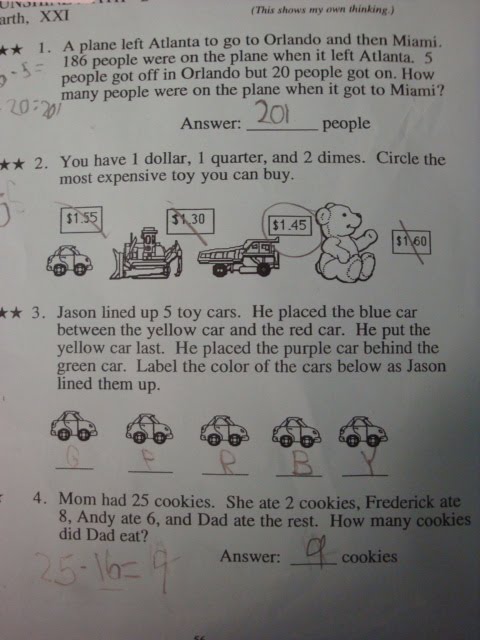
When I first heard the idea of an Exit Ticket, I jumped too quickly to the conclusion that I would gain the same information from a quiz or assessment. But, after implementing them on a trial basis consistently for several weeks, I realized that they had tremendous value for gathering data and giving immediate and consistent feedback to students. It was the difference between assessing with a summative (a quiz or test) and a formative which helps guides the next day’s lesson. I would recommend the use of Exit Tickets to any math teacher who is serious about offering differentiated math instruction to meet the needs of each of their students.

Tuesday, March 30, 2010

Did He Get The Right Answer?

My youngest son is a Second Grade student at Chets Creek Elementary and is being raised in a math learning community that values young mathematicians and works hard to develop their number sense. Since Kindergarten, his learning hasn't consisted of rote procedures and memorization, rather his teachers have cultivated his number sense, stretched him to solve problems using a variety of strategies, and embedded problem solving.

Today, coming home from school, he pulled out his Sunshine Math sheet and got to work. (The Sunshine Math program is run by our PTA and is an optional program that students can sign up for at the beginning of the school year. The weekly sheets offer math challenges for students to complete independently. Students get the sheets on Mondays and turn them in to the PTA on Fridays. PTA volunteers correct the sheets and return them to students. Students are rewarded periodically by PTA for their participation and at the end of the year, the teachers host a Math Challenge Day for students to compete.) Most of the time, the questions are rich contextually based problems which promote my child's problem solving skills. However, today, on the back of the sheet, there were a set of problems that looked very traditional.

The problems themselves didn't give me angst, rather the way the traditional problem pigeon holed my child into solving using a particular strategy-the traditional regrouping algorithm. Notice problem d. Now, humor me, if you will, and write this problem down on a sheet of paper. Then, solve it.

Most of you, like me, probably solved this problem using the traditional algorithm and got the answer easily.

Now, take a few moments to consider how my son solved it.

At quick glance, you may, like the volunteer that will use an answer key to score my son's paper, mark his answer incorrect. However, if you take a closer look, you will see that he is correct. He gave the answer 17 because he did not use the traditional regrouping algorithm, and he did not adhere to the confines of the boxes. He looked at this problem and said, "Six take away nine is negative 3." You can see where he recorded the -3 in the box. Then, he said, "Fifty take away what will give me 20? That must be 30." He recorded the 3 in the tens place box. Next he said, "Twenty take away three is seventeen." He did this all in a matter of seconds and then double checked his work to prove that 56-39=17.

Since I knew that they wanted him to get the answer 27, and I was intrigued by his thinking, I wrote the problem 56-29 on a sticky note and asked him to solve. A second later, he handed me back the correct answer of 27. I said, "Tell me how you solved it." He replied, "I know 50-20 is 30 and 6-9 is negative 3, so the equation is 30-3 which equals 27." He used a left to right strategy to solve and is very comfortable with negative numbers. I said, "How did you know 6-9 is negative 3?" He said, "Do you want me to prove it to you on a number line?" He's eight years old!

I was very intrigued the moment I saw what he'd done with this problem on our car ride home. I've been an intermediate math teacher; I've been a math coach; I've worked as a math consultant. And, I've seen far too many math practice books, websites, and even state adopted textbooks that have this type of problem in them. They look harmless enough, but for kids who think mathematically and even for those in the process of developing their number sense, they can be detrimental.
I am thankful that my son has not had teachers who teach him to solve problems procedurally using only the traditional algorithm. He's been blessed to have an incredibly talented set of teachers that offer instruction to cultivate a students' mathematical thinking. Because of Mrs. Mallon, Mrs. Dillard, Mrs. Ross, and Miss Russell, Carter is a mathematician.

Sunday, November 16, 2008

The In-Between Game, Grade 5

On Friday, we streamed our first live videoconferenced math lessons of the year into our district's professional development site, the Schultz Center for Teaching and Leadership. Approximately 100 Academy of Math participants from around the district gathered at the site for a day of PD. And, one component of the day was watching and debriefing a math lesson from the grade level you teach. Our live streams, from CCE, came from Kindergarten and Grade 5.

As a coach, I attend as many of the live lesson streams as possible, because classroom observation and classroom supporter is part of my role. And, on Friday, I must say that I was right at home, having taught on the Grade 5 Math/Science Team for four years myself.

The Grade 5 lesson was live from Bridget O'Connor's classroom. Bridget's students are currently in a unit of study focusing on fractions, decimals, and percents. Her mini-lesson focused on introducing students to a new game, In-Between. In the game players take turns placing a card next to another card. The card can be placed to the right of 10%, to the left or right of 50%, and to the left of 90% (think it like a number line), or under a percentage card if it is an equivalent fraction. As students place the cards, they explain their reasoning by stating the fraction and the equivalent percentage. The cards, as you look from left to right, must be in correct numerical order. They cannot place a card between two cards that are already touching. For example, if 1/6 was played touching 10% card, then 1/8 could not be played. The goal of the game is to try and place more cards than your competition. The student voluneer and Ms. O played a practice round, from the board in the front of the room, so students would be ready to tackle the game in pairs.

As the class transitioned from their mini-lesson to Work Period, Bridget pulled a small guided math group. She reexplain the directions and got the students started. She observed during their first round to make sure they understood and then began circulating the room conferring with pairs of students. She listened in on student's conversations, asked them probing questions, took their strategy in the game to the next level, and took notes if she wished to share their strategy, question, or conversation in Closing Session.
As I watched Bridget in action, I stayed as far out of site from the video camera as possible, but sat with pairs of students to listen in on their conversation and strategy. I was enamored with the depth of their thinking. I overhead one student say to another, "Why are you placing 3/8 next to 1/4?" And, the other replied, "I know 3/8 is 37 1/2% because 1/8= 12 1/2% and 2/8 is equivalent to 1/4, which equals 25%, so 3/8 is 12 1/2% + 25%." She went on to say, "I placed 3/8 there because I am blocking you from begin able to play your 2/6 card." She giggles, "You will get stuck with that card!" In another conversation, I heard one young man say to another, "I'm saving all my equivalent fraction cards for last (1/10, 1/2, 9/10), because I can always play them under the percentage cards." He continued, "I am wasting a turn if I place them any sooner."

After about 25 minutes of Work Period, Ms. O'Connor had students return to their seats for Closing Session. Once again she used the giant sized magnetic game board she had created at the front of her classroom to demonstrate. She focused on a few relevant conversations and strategies to move student thinking forward.
1) "One student moved the percentage cards further apart even after fraction cards were placed. Why did he do this?", she asked.
2) She presented a comment that was asked of her as she circulated, "Ms. O, we need to think fast, don't cut ourselves off, and look at my partner's cards before I make a play." She asked the students, "What does this mean?"
3) Ms. O asked a student to come to the front and present a strategy she saw him use, because he had formed a misconception. After working it out in front of the class, he discovered his error, corrected it, and decided he was leaving his equivalent fractions for last.
4) She asked, "Why did it take you longer to place the cards like 1/6, 5/6, 1/8, and 3/8?"

The Closing was interactive dialogue between the students and teacher. I think you'll agree it is a powerful part of the workshop model, one that should never be missed. And, one in which the student learning is deepened and where they build powerful connections.

This game, the In-Between Game, is one of student thinking, understanding, and connecting. It is also a game of strategy with the added element of a little luck--the students quickly figured out that they loved the equivalent fraction cards. And, there are many variations. I'm sure you'll agree that this is a game students should revisit frequently during Choice Time, and one in which they will become very strategic. Now, that is the way to develop young mathematicians!

Saturday, November 8, 2008

EDC Math Videotapes Grade 3 & Grade 1

Every Day Counts® Calendar Math is a supplementary curriculum tool that we use in addition to our core curriculum TERC Math Investigations. These two programs fit nicely together to form our 75 minute math block. Every Day Counts Calendar Math reviews, previews, and reinforces NCTM grade level standards.

As a source of professional development within our school, CCE teachers have graciously agreed to be videotaped to share their instructional practices with others. The Every Day Counts Calendar Math lesson plans are read and implemented by each of our teachers, but implementation may look slightly different in each classroom. Therefore, the videotaping of lessons each month assists all of our teachers in reflection of their own practices, and allows them to virtually visit one another's classrooms.


To watch Ashley Russell's 3rd grade EDC Calendar Math, click here.


1st grade - Calendar Math 10-08 from Melanie Holtsman on Vimeo.

Wednesday, October 1, 2008

Kindergarten Snapshot: A Look at the Afternoon

This afternoon, I took a stroll through Kindergarten. In many of the rooms, the teachers were knee deep in Science Workshop. These are a few highlights from my visit.

In the first room, Science Workshop was in full swing. Students were busy making observations as they circulated through five different stations. Each station focused on a different sense and students excitedly gathered information. The teachers were facilitating instruction as they circulated to each station. I could overhear them asking, "What does it taste like?" "What do you hear?" "What do you think is in the bag by feeling it?" "Why?" The young scientists were eager to make predictions based on their observations and student engagement was high.

In another room, young scientists were busy using balancing scales to measure objects at their table. They were sorting items into two different groups based on the weight of the objects. Students were working nicely in pairs to accomplish their task and the teacher was assisting as she circulated from one pair to the next.

Our young scientists in another room were focused on their sense of smell. They had read a text on the sense of smell, and were in work period drawing things that they could smell. Students' work indicated that they could smell items like flowers and food. The students were eager to share their work with me and really wanted me to photograph their work. :)

In one room, Math Workshop was in session. Young mathematicians were busy creating patterns during work period. When I asked one student to explain their pattern to me, he replied, "I built a blue yellow blue yellow pattern." I asked another student who exclaimed, "I build an A B B A B B A B B pattern." I questioned, "How do you know?" She proudly explained that she had a shape and then two squares, and then the shape and then two squares. Her reply caught the attention of another child at her table who quickly cleared her pattern. I asked her why she cleared her pattern and she said, "I'm going to make mine harder." "Sounds like a great idea to me," I exclaimed, before moving on.


The morning in Kindergarten is packed with ELA: Skills Block, Writers' and Readers' Workshop. Afternoons are generally reserved for Math and Science Workshop. So, I'll visit again soon and give you a snapshot of a Kindergartener's morning.

Wednesday, September 10, 2008

Every Day Math Counts

Yesterday, three of our math teachers graciously opened their doors so three colleagues from a neighboring school could observe and learn more about Everyday Math Counts. Everyday Math Counts is a supplementary program that our district adopted last year to use in addition to our core math program, TERC Math Investigations. EDC is taught everyday in Kindergarten-Grade 5 for approximately 15 minutes in an effort to preview, review, practice, or discuss math skills and build mathematics number sense.

The visiting teachers observed two EDC lessons, one in Grade 4 and one in Grade 5. The Grade 4 EDC lesson was done in a co-teach classroom, so after the lesson, one of the teachers had the opportunity to debrief with the visitors. They asked questions about the parts of the EDC lesson, how we got started, the process of implementing the program school-wide, and how the curriculum was different across grade levels.

After the Grade 5 EDC lesson, which I watched with them, they asked to walk through math classrooms on multiple grade levels. As we walked, and talked, they noticed that every math teacher had a bulletin board with EDC artifacts which were up to date, that each classroom taught the same elements, and that each student had a recording system for taking notes whether it was a sheet made up by the teacher (Grade 4) or a composition notebook (Grade 2,3,5). In addition, they were very interested in the EDC quizzes our teachers created to hold students accountable for their learning during this time. They also asked me about last year's math results. Had we seen an increase in scores due to EDC implementation, they wondered. I shared our data with them--92% of all our students scored 3 or better in 2008 on the Math FCAT, a one point increase over 2007. 78% of the students in the lowest quartile made a year’s worth of learning gains, an increase over previous years, and student achievement for Students With Disabilities rose significantly from 74% to 84%. The variable that changed last year was EDC for all students.

Though EDC could not stand on its own as a math curriculum, it certainly fills the gap as a supplemental program. And, I noticed yesterday as I walked rooms that our teachers have done an outstanding job implementing this program. I sincerely appreciate that our teachers have embraced this program wholeheartedly, implemented authentically, and are always willing to open their classrooms to other educators. I know they are impacting student achievement far beyond their classroom walls.

Tuesday, November 6, 2007

A Focus on Mathematics

To become fluent mathematicians, students need to build understanding and connections in math skills, concepts, and problem solving. Chets' teachers are committed to teaching in a Math Workshop format which fosters an environment safe for students to explore multiple strategies.

Math instruction does not consist of a teacher showing students a set of procedures to solve a problem. And, does not require students to regurgitate an answer. We foster the process. We foster student's next steps. We foster understanding. This is a much different approach in contrast to traditional math education in this country, and one we embrace and celebrate for the achievement of our students.

However, we know that because teachers were not taught the way we are now teaching, professional development must take center stage. Therefore, our principal makes sure to support a math coaching position in her budget. Presently, two coaches share that one position. They share a classroom, and each have half a day of release time to coach in other classrooms. Weekly they run teacher meetings in grades 3-5 where teachers discuss curriculum and instruction, analyze diagnostic assessments, work on common assessments, analyze student work, discuss professional literature, and explore multiple strategies. They also have an entire day each quarter to spend with a grade level where they observe demonstration lessons and debrief the lessons.

In grades K-2, two math teachers who carry full day classroom loads, act as math lead teachers. They run their grade level teacher meetings and WOW Days. On occasion, they are released from their classroom to coach in other classrooms.

In addition to coaching, we embrace digital professional development. We've utilized Math Video Clips of two of the coaches talking teachers through math strategies in addition, subtraction, multiplication, and division. I'm sure they will be delighted that I've linked you to their site :) We've used video streaming demonstration lessons, and one of our math leads, Melissa, has used her blog to begin sharing s wealth of information including linking sites to her posts that she finds useful for students to use from home. Two other sites I've found helpful include the National Library of Interactive Math and a Teacher Resource site. Also, we've used our CCE website to share math information.

You'll notice as a list on this blog, I also recommend math texts that every math teacher and coach should have in their bag of tricks. If you have further suggestions for professional development that we can embrace to move our work forward, please pen me a comment on this post. I'm looking forward to hearing from you!