In a previous post, I shared with you my excitement about heading back to the classroom this year. And, though I am utterly exhausted during this second week of school, I am also calmly reflective and overwhelmingly renewed, reconfirming for me that I am exactly where I should be at this point in my learning journey, with the children.
It's been fascinating coming back into the classroom not only with my teacher's eyes, but from the perspective of a coach, too. Things have caught my attention that might otherwise quietly pass, because I am intrigued by the small details that make all the difference in the big scheme of things. I feel called to try and document my experiences this year, though I admit that classroom planning and sleep have won out over all else the past two weeks. I'm sure many of you reading this can certainly relate. However, just so you know, I am committed and there is a post in the works on the Rituals, Routines, and Expectations so student learning time throughout the year is maximized. If you are a system's thinker, you'll definitely want to stay tuned.
Finally, I wanted to invite you to join me at http://www.solar3rd.blogspot.com/. The blog is the combined effort of my SOLAR (Shall, O'Leary, Lipsky, and Russell) Power team this year as we guide and educate our young learners.
Wednesday, August 31, 2011


Saturday, August 20, 2011
Orientation
Last week, just days before the teachers returned to work, students received a postcard in the mail from Mrs. Phillips announcing their homeroom teacher. Children and their parents eager to meet the new teacher, joined us for an Orientation on Friday before the new school year begins.
You know what they say, "You only have one time to make a good first impression." So, teachers take great care in the way they set up their classrooms, dress for success, and display personal touches of love. What parents mostly want to know is if the teacher is nice and if their children will be loved during this 180 day learning journey.
To prepare, Ashley and I set out Orientation packets and made Batman Cookie Medals for the kids. We set up a back table for easy sign in, pulled out chairs, and had a established place for them to unpack the their child's school supplies. We made sure each student's desk was already labeled with their name so they would know exactly where to sit when they entered the room on the first day of school. We organized our thoughts on a themed PowerPoint to use after we welcomed parents to highlight some main points. But, mostly what we did was make them feel welcomed, loved, and excited to return on Monday. We can't wait for the learning adventure to begin. Stay tuned...


You know what they say, "You only have one time to make a good first impression." So, teachers take great care in the way they set up their classrooms, dress for success, and display personal touches of love. What parents mostly want to know is if the teacher is nice and if their children will be loved during this 180 day learning journey.
To prepare, Ashley and I set out Orientation packets and made Batman Cookie Medals for the kids. We set up a back table for easy sign in, pulled out chairs, and had a established place for them to unpack the their child's school supplies. We made sure each student's desk was already labeled with their name so they would know exactly where to sit when they entered the room on the first day of school. We organized our thoughts on a themed PowerPoint to use after we welcomed parents to highlight some main points. But, mostly what we did was make them feel welcomed, loved, and excited to return on Monday. We can't wait for the learning adventure to begin. Stay tuned...
Desks are set up and ready for Orientation.

Lovingly made themed cookie medals send the message to children that we care about them.


Sign in table, volunteer sign up, and wish list items on stars make it an easy one stop shop.

Creating a place for school supplies helps relieve stress and congestion, and makes for easier put away when Orientation wraps up.

Our Third Grade Classroom
The preparations are well underway as an exhausting yet thrilling week of pre-planning comes to an end. Our superhero theme, Empowering the Future, made it easy to decorate for the student WOW factor, and no detail was overlooked as we strived for an organized classroom that would provide purpose and limit student transition time between activities. I feel like we were thoughtful and successful in setting up a learning community that will meet the needs of our students and ourselves. Take a sneak peek inside our classroom before the learning journey begins...


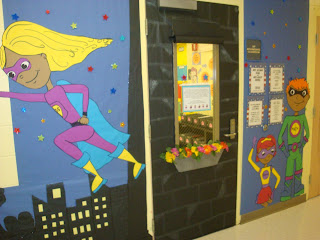




The Hallway of Our Learning Headquarters
Upon rounding the corner, the hallway comes alive with color thanks to the hard work of a parent volunteer who graciously gave up days of her summer to help us WOW our future students. The black clothespins fastened securely to red construction paper await the hanging of student work that soon will adorn this Hall of Fame.

We welcome all superheroes on this year's learning adventure!

At the bottom of our yellow promotion cards, filled out on every student at the end of each year, the teacher writes something good about the student. The incoming teacher uses that valuable piece of information to make sure that every student feels loved as they enter their classroom on the first day of school in the new year. This tradition titled, I know something good about you, has been a Chets Creek tradition since our doors opened in 1998. This year my co-teacher, Miss Russell, had the great idea of creating bookmarks to post the Something Good About You sayings so when the board comes down students can track their reading with their new bookmark.

The Math, Science, and Social Studies heroes are ready to go outside the Headquarter of Learning.

Our classroom plaques remind us of our Guiding Vision, Learner Outcomes, and Core Values.

A sneak peek inside our classroom... You may notice the stars over each table which have been set up purposefully with table groups and numbers that will be used for rituals and routines around gathering materials and working in small groups.

The bare walls are departmentalized with an area designated for math, science, and social studies artifacts. Hot gluing plastic clips makes it easy to put up and remove necessary charts as student learning unfolds.
The cubbies are numbered with a metal shelf in between to make sure that student back packs are organized and are not a distraction to learning.

There is a corner designated for our Math EDC area. Calendar, clocks, two hundreds chart, measuring tools, place value charts, thermometer, counting tape, and math manipulatives are set up and ready to go.

Calendar

Place Value Chart

Organized and Labeled Math Manipulatives

Counting Tape--Set up in groups of five and ten will make it easy to record each day of the school year. Cards are waiting for numbers 1-180 and students will look for many patterns along the way.

Our classroom has a gathering area were students can come to the floor and be up close and personal for classroom lessons. To secure the carpets, double sided tape works like a charm.

The board set up with colored masking tape allows for ease in recording the day's events and essential questions. Notice that just below the whiteboard our number line is easily seen and reachable by all students.

Above the board, we have math strategies posted.

Math and Science Portfolios and items used for Tuesday Folders.

The word wall, though blank, is set up and ready for learning. Velcro dots secured to laminated posterboard and attached to the classroom cabinets leave plenty of space to display words. The words are pre-made on Avery labels that have been attached to index cards and laminated. The front of the card has the word and the back of the card has the definition. After words are embedded in classroom instruciton, they can be easily found placed on the word wall from pencil pouches organized in a three ring binder by unit. The words can be taken down by a student if they need to look up a definition and placed easily back on the chart with the velcro.
Thank you to Melissa for such a great system that keeps on giving! We miss you!


We have five student computer stations in our classroom. In addition, Miss Russell and her former co-teacher, Mrs. Ross, were selected as technology magnets in our district, so we are blessed to have a laptop cart, too. We will certainly put them to good use this year!

Our PTA sponsors Sunshine Math, an additional math homework sheet, used to push student learning to new levels. We are prepared to record and reward students who are going above and beyond the call of duty.

In third grade, students will learn how to multiply and divide. We have two doors in our classroom designated to record student progress. As they master a set, they will get to "sign the door."

Student work bulletin board is ready for some SUPER work!

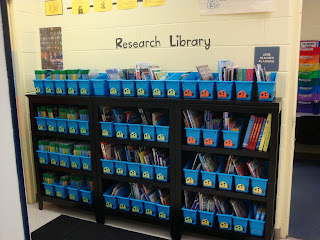
With part of our science textbook adoption, we received leveled science readers. We removed the books from their boxes, organized them by their science content and put them out in our Research Library.

Each day when students enter our classroom, they will receive two SOLAR dollars. They will log their money in their account books and keep their money in pencil pouches in the pouches on the back of their chairs. Students will have the opportunity to save their money and spend it on our store items when the store opens each week. We have items to buy, but more maybe more popular, items to rent. Offering items like Teacher Assistant, special desk, special chair, and extra computer time are great perks that don't need to be replenished by the teacher. Kids can also rent popular games and have time to play during Store Hours.
(Displayed beside the Store is our birthday wall and this year students will get to wear a birthday cape on their special day. Pictures to follow soon.)


Science can be messy business and time consuming, but with prearranged rituals and routines, it doesn't have to be. These cheap ($2) trays are labeled by table number and already contain student maginifying glasses. In the morning, science items for experiments and labs can be set up, and student handlers can easily transport their trays during classtime.

I hope you enjoyed the "sneak peek." Stay tuned as we begin this year's learning adventure...
Thursday, August 11, 2011
Empowering the Future
Learning Leaders will emerge from summer vacation and return to another exciting school year in just four short days. As always, we will be greeted with a new school theme and a 180 teaching days full of new possibilities. With this school theme, I know the kids will transform from tired eyed and groggy to alert and energized! The Learning Headquarters are going through a supersized superhero transformation as we speak. Stay tuned...
Chets Creek Elementary – Empowering the Future! from Melanie Holtsman on Vimeo.
Chets Creek Elementary – Empowering the Future! from Melanie Holtsman on Vimeo.
Tuesday, August 9, 2011
A New Learning Journey
After much time and consideration during the last year, I've made the decision to return to my roots and head back into the classroom. I couldn't be more excited. Over the past decade, other than a short one year hiatus to another state, I've been dedicated to moving curriculum and instruction forward in our elementary school as the Instructional Coach. And, though I've enjoyed every moment, I'm overjoyed to embark on a new opportunity.
This year's learning journey will have me teaching in a third grade departmentalized co-teach setting. Miss Russell and I will share a classroom and have a group of 36 learners in the morning and a different group of 36 learners in the afternoon. We will teach Math, Science, and Social Studies.
My partners and I, known this year as Solr Power due to our superheroes-Empowering the Future- theme, will have a classroom blog dedicated to communicating with our parents and students. However, most likely, some of my thoughts will end up here, as they won't be relevant to the other blog's purpose. Stay tuned as the new journey begins...
This year's learning journey will have me teaching in a third grade departmentalized co-teach setting. Miss Russell and I will share a classroom and have a group of 36 learners in the morning and a different group of 36 learners in the afternoon. We will teach Math, Science, and Social Studies.
My partners and I, known this year as Solr Power due to our superheroes-Empowering the Future- theme, will have a classroom blog dedicated to communicating with our parents and students. However, most likely, some of my thoughts will end up here, as they won't be relevant to the other blog's purpose. Stay tuned as the new journey begins...
Friday, April 29, 2011
Exit Tickets
As math educators, we must make broad judgments daily about whether the class understood the day’s lesson before we move on with instruction the next day. The pulse of the class is taken easily because of the level of student interaction and discussion during the questioning segment of the lesson, but it’s harder to get a clear picture of what individual students have mastered and are able to do independently. Though whole group instruction may move forward the next day, it is our responsibility to ensure that all students are reaching mastery. We need to know specifically students who need small group reteaching or more support for success. Because, at CCE we are aware that retention rates for students are highest when they teach others (90%), practice by doing (75%), and partake in discussion groups (50%), many days my students are working in pairs or small groups in math. There is not always the opportunity to collect independent student work, so we needed another teaching strategy to accomplish the goal of knowing whether every student was at mastery on the day’s work.
Exit Tickets have become our answer. An Exit Ticket is a formative teaching strategy given immediately after the Math Workshop concludes which focuses students on the core content of a lesson and promotes a quick and independent assessment check. Each student answers a question or two that targets the big idea for the day. The checkpoint, taking only a few minutes, offers teachers the immediate opportunity to check students’ independent mastery of the day’s content.

 Students quickly began to find equivalent fractions like ½=3/6, 1/3 = 2/6, and 2/3 = 4/6, and make generalizations like, all fractions that contain denominators twice as large as the numerator are equivalent to ½.
 Within minutes, we had sorted the students’ work. Some students easily, accurately, and articulately answered the questions and needed no further instruction. Some students answered the questions correctly but their explanation of the equivalencies was not articulate enough to know whether they fully understood the concept. These students would need a quick conference to identify whether they fully mastered the concepts. In some cases, we found that no further instruction was needed, but in other cases, we found that there is a gap in knowledge and small group instruction is needed for mastery. The third group of students could not accurately answer the questions and we formed a small instructional group to offer more instruction and practice.
When I first heard the idea of an Exit Ticket, I jumped too quickly to the conclusion that I would gain the same information from a quiz or assessment. But, after implementing them on a trial basis consistently for several weeks, I realized that they had tremendous value for gathering data and giving immediate and consistent feedback to students. It was the difference between assessing with a summative (a quiz or test) and a formative which helps guides the next day’s lesson. I would recommend the use of Exit Tickets to any math teacher who is serious about offering differentiated math instruction to meet the needs of each of their students.
Exit Tickets have become our answer. An Exit Ticket is a formative teaching strategy given immediately after the Math Workshop concludes which focuses students on the core content of a lesson and promotes a quick and independent assessment check. Each student answers a question or two that targets the big idea for the day. The checkpoint, taking only a few minutes, offers teachers the immediate opportunity to check students’ independent mastery of the day’s content.
Exit Tickets are simple and time efficient to create and analyze. When preparing for a lesson the teacher has to think, “If I teach this math concept or skill effectively, which question should students be able to answer at the end of the lesson?” This question or two should align with the big idea.
Typically, we create an Exit Ticket on a ½ sheet of paper for easy distribution and collection. Having it on a ½ sheet of paper makes it effortless to sort students’ work into piles once the task is complete and collected. Within minutes, you can have several stacks of student work. One stack of student work proves independent mastery of the lesson, the second stack contains student’s work where mastery is not clear and more information is needed, and the third stack demonstrates work with misconceptions or lack of understanding. Students whose work is in the first pile need no additional instruction; Students whose work is in the second pile need a teacher to confer with them so they can explain or justify their answer because the written work did not prove mastery. With this quick conferring session, the teacher can tell whether or not additional instruction is needed. If additional instruction is needed, the teacher can pull the student into a small group during the next day’s Work Session. Students whose work is in the third pile need small group reteaching to acquire more knowledge on the concept or skill. In addition, they may need more strategic questioning during whole group instruction and more feedback during the Work Session as the concept or skill is developed.
As a rule, the whole process of Exit Tickets takes little time and provides great benefit. Teachers don’t have to wait for a summative check on a math quiz or assessment, they have the formative Exit Tickets that help them prescribe instruction along the way and help prevent misconceptions or gaps in knowledge.
Third Grade Exit Ticket Example:
Third Grade Exit Ticket Example:
During a unit of study on developing and understanding fractions and fraction equivalence, students needed to be able to use models to represent equivalent fractions and identify representations of equivalence. To get started, we had students work with pattern blocks. They identified the yellow hexagon as one whole, a red trapezoid as ½, a blue rhombus as 1/3, and a green triangle as 1/6. They created equations like ½ + ½ = 1, 1/3 + 1/3 + 1/3 = 1, and 1/6 + 1/6 + 1/6 + 1/6 + 1/6 + 1/6 = 1.
Additionally, we taught students to find ways to make one whole using combinations of halves, thirds, and sixths with pattern blocks as their tool and write equations. For example, ½ + 1/3 + 1/6 = 1.
Students quickly began to find equivalent fractions like ½=3/6, 1/3 = 2/6, and 2/3 = 4/6, and make generalizations like, all fractions that contain denominators twice as large as the numerator are equivalent to ½.After several lessons, we played a game in which students received a recording sheet of yellow hexagons. Students rolled a fraction die and had to add that fractional piece to one of the yellow hexagon pieces. The object of the game was to fill in all their yellow hexagons.
During the two days of lessons using the pattern block manipulatives much of our discussion was in student pairs. We weren’t confident that every student had transferred our classroom conversation to independent mastery, so we used an Exit Ticket at the end of Math Workshop on Day 2 to formatively assess students. The students were given three minutes to complete the task and then we collected their work. In the first problem, students had to write an equivalent fraction for 3/3, 3/6, and 2/6, and in question number two they had to answer the following question, William had a fraction cookie with the equation ½ + 1/6 + 1/6 + 1/6. Sebatian told William that he could just write ½ + 3/6 or ½ + ½. Is Sebastian right? Explain.
Within minutes, we had sorted the students’ work. Some students easily, accurately, and articulately answered the questions and needed no further instruction. Some students answered the questions correctly but their explanation of the equivalencies was not articulate enough to know whether they fully understood the concept. These students would need a quick conference to identify whether they fully mastered the concepts. In some cases, we found that no further instruction was needed, but in other cases, we found that there is a gap in knowledge and small group instruction is needed for mastery. The third group of students could not accurately answer the questions and we formed a small instructional group to offer more instruction and practice.When I first heard the idea of an Exit Ticket, I jumped too quickly to the conclusion that I would gain the same information from a quiz or assessment. But, after implementing them on a trial basis consistently for several weeks, I realized that they had tremendous value for gathering data and giving immediate and consistent feedback to students. It was the difference between assessing with a summative (a quiz or test) and a formative which helps guides the next day’s lesson. I would recommend the use of Exit Tickets to any math teacher who is serious about offering differentiated math instruction to meet the needs of each of their students.
Saturday, March 5, 2011
A Few New Math Ideas
A colleague and I facilitated math training for teachers in Texas in mid-February. Each training day included lesson pre-briefing and planning, a classroom math observation, and a debrief of the lesson afterward. Teachers made rich connections, gained new ideas for their instructional practice, and gained a deeper understanding of a Math Investigations unit of study. Though my main focus was on the learning of the teacher participants, I also couldn’t help but take away a few reflections of my own.
Archiving Student Work
The classrooms we visited do a stellar job of archiving students’ math work. Each student has a composition notebook with a Table of Contents in the front. The pages of the composition notebook are numbered and each day the teacher has students add the date, math title, and pages of the journal they've consumed. We could easily turn to the pages listed in the Table of Contents to see what work the student had done for that day. In the notebook, they may solve a problem, explain a solution, do an extension activity, or answer an essential question during their Closing Meeting. Providing a great way for students to reflect and a resource for studying for assessments, I loved the possibilities of this tool.


Extension Activities
At Chets Creek, we use standards to write yearly pacing guides, plan instruction, and assess students. In making our work transparent, students become familiar with the standards we expect them to master. Many times the way a teacher implements this best practice is by having an essential question, written in standards language, posted on the board. In their math lesson they go over the essential question which students revisit and answer in their Closing Meeting. At NISD, I noticed that not only did the teachers write the essential question for the day, but they also had an extension activity written next to the essential question. When some of the students finished early on their task, they didn’t say, “I’m done! What now?” instead they got to work on the extension question. What an easy way to extend student learning!


Visual Word Walls

Skip Counting on the Number Line
Number lines are a permanent artifact in our math classrooms, however this number line included colored dots that are used for the students use in skip counting. For example, if a student followed the red dots, they could easily skip count by twos, and if they read the yellow dots, they would be skip counting by fives, etc... I could easily see this as a great tool in elementary classrooms, especially in K-3rd grade. Afterall, skip counting/repeated addition is the foundational element in multiplication.

Walking into another teacher's classroom offers so much opportunity for gleaming new ideas. Whether you do it in your own building, like our Kindergarten teachers did two weeks ago, or in another school, you gain so little without consuming too much of your time or energy, and gathering just a few new ideas leaves you with a wealth of new knowledge over time. I can't wait to see if any of these new ideas are embraced at CCE. Stay tuned...
Subscribe to:
Posts (Atom)