Tuesday, May 4, 2010

New Team Planning

Today, we kicked off the first of our New Team Planning Meetings with the incoming 3rd grade team. We believe, the meetings, unique to the way we prepare for the upcoming school year, are vital for team cohesiveness. It is not uncommon at The Creek for teachers to transition between grade levels, therefore teams always have new members. We believe, as the quote on our agenda stated that “Planning is bringing the future into the present so that you can do something about it now.” The pre-planning allows everyone to get to know each other, obtain a clear vision for the expectations and demands of that particular grade level, and ask questions and receive immediate answers. This one day gets everyone off on the right foot and brings a sense of calm.

Our morning began with a team building activity designed for teachers to learn more about one another and get the day started with a few hearty laughs. Then, the first topic of business was selecting a Team Leader to represent the interests of the grade level teachers at the shared decision making table and provide leadership to the grade level throughout the year. In third grade, the team nominated and appointed Vicky Cole to this position. After that, the team discussed Committee Chairs for positions like Target Team observers, Spirit, Technology, Play, etc. The third grade team was eager to volunteer and it was evident to me that many teachers were willing to fulfill leadership positions on the team. Always a good thing to ensure team cohesiveness!

Our next order of business was reviewing and clarifying the grade level's non-negotiables list as outlined by the America's Choice School Design and our CCE School Improvement Plan. I will post this complete list at the end of this blog post, if you wish to review the items this team has agreed to follow.

Third Grade teachers are departmentalized by subject area, therefore for the next part of our agenda we broke into two groups, the ELA department & Math/Science/Social Studies department. In each group, we conferred about the New Generation Standards, talked about inventories, common assessments, homework, grading, and diagnostics. In addition, in ELA, we spent much of our time on looking closely at our ELA Pacing Guide and revised it based on consensus for the 2010-2011 school year. This part of the agenda certainly brought clarity to each of the team members.
The professionals then went out to lunch together. This well spent time brings a lot of opportunity for conversation and collegiality, and is an important part of the day that should not be overlooked.

Afternoon dialogue focused on penning a grade level Supply List, and then on our digital resources. Led by Cheryl Chascin, teachers updated their On Course Teacher WebPages, and then logged in and explored Discovery Education.

The end of the agenda reminded teachers, “All the flowers of all the tomorrows are in the seeds of today.” And, I think they would agree that today, they planted many seeds they will reap the harvest of next school year.
_________________________________________________________
Non-negotiables

Subjects

--One hour Readers’ Workshop
--One hour Writers’ Workshop
--15-20 minute Interactive ELA Skills Block
--One hour Math Workshop
--15-20 minute Interactive Math Skills Block
--45 minutes of Science / Social Studies

Homework
--No more than 45 minutes nightly (Monday through Thursday), no homework on weekends.
--Coordinate the assignment of projects with members of the team. Revisit and align projects to New Generation Standards. Project assignments may go home on weekends, but only to provide students and parents additional time to secure materials. Project work counts in the 45 minute homework time limit. Research may count as reading time.
--Students are encouraged to be actively involved in extracurricular activities, spending a limited time on homework while building rituals and routines around study skills.
Million Word Standard
--Each student is responsible for reading a million words a year.
--Evidence will be logged through a book log. (Book logs can be paper/pencil, digital, school based or home based)

Artifacts
--Standards, for the daily lesson, should be displayed and printed large enough to be read by students from their seats.
--Book of the Month attractively displayed and accessible.
--Data Notebooks (Diagnostic Profiles, DRA’s, PMP)
--Portfolios in Writing, Mathematics, and Science
--Word Walls
--ELA: mini-lesson charts (teacher made), writing rubrics, Reading Response Journals or Notebooks, and Writing Notebooks or Seed Journals--Math: teacher made charts, 100’s chart, number lines with negative and positive numbers, manipulatives, and strategy charts
--Science: teacher made charts; Scientific Method posted; evidence of an inquiry based laboratory; and Science journals, notebooks or portfolios--Student work posted (on the walls in the classroom, preferred, but if space is limited hallway display is acceptable)

Standards- Based Bulletin Boards
--SBBB will be displayed by the deadline date and should include: Standards, Task, Circumstances of Performance, 4 pieces of student work, and teacher commentary. Student commentary is optional.
--No SBBB are due in August, December, March, or May. April's board should be work over time.
--Co-teachers in departmentalized grade levels will alternate between ELA and Math/Science/Social Studies.
--Teachers are encouraged to produce a variety (subject area and work product) of different SBBBs across the grade level. Each should be original and creative.

Standard Snapshots
--Go home with report cards on the 1st, 2nd, and 3rd nine weeks.
--Should be created collaboratively with an emphasis on discussing student work.
--Each student’s piece of work will be attached to the snapshot to be sent home on the specified date.
--ELA team will produce three Snapshots (reading or writing); Math/Science team will produce three Snapshots (math or science).
Pacing Guides
--District Learning Schedule in Mathematics
--District Learning Schedule in Science
--ELA CCE Pacing Guides, prepared using the Scope and Sequence in our district adopted Houghton-Mifflin Text and the Sunshine State Standards
--Author Studies, as outlined in our SIP, will be delivered following the pacing guide schedule.

On Course Grade Book
--Homework grades are for habits and process, not accuracy or content.
--Projects will not be graded if they are completed at home.
--5 or more grades in each subject area, every grading period.
--Subject area teachers MUST agree on what is being graded and how the grade is derived. Parents must be informed.
--Grades should be posted to the grade book within one week.
Communication with Parents
--Weekly newsletters
--Written notes in planners or email
--Blogs are highly recommended but optional.

Sunday, April 25, 2010

Arts Extravaganza


Walking into our front lobby you can feel a school that has come alive! It's Arts Extravaganza week, one of my favorite times of the whole school year. Our nearly 1,300 children have created beautiful artwork that adorns our hallway walls and their framed work hangs on display in the lobby ready for sale to their parents during our two night Art Show.

The Cultural Arts Committee, led by master art teacher, Jennifer Snead, has put together an incredible week for students that is highlighted each morning with an assembly. Students have been drawn in by a puppeteer, dance and music ensemble, storyteller, Bluegrass performance, and Jacksonville Symphony drummers.

In addition, Arts Extravaganza Baskets assembled by our Room Moms and teachers are on display in the front lobby to be auctioned off Friday evening with funds going to the PTA to support next year's Arts Week.

As the culminating activity on Friday evening, Arts Extravaganza Family Night is hosted by our Cultural Arts Team and PTA. Throughout the lobby and Dining Room children will find artists and musicians displaying their talents, and art stations are set up for students to produce their own small treasures. I don't know of any school that celebrates the arts quite like ours, and I am ecstatic that our students have this enriching experience.


Tuesday, March 30, 2010

Did He Get The Right Answer?

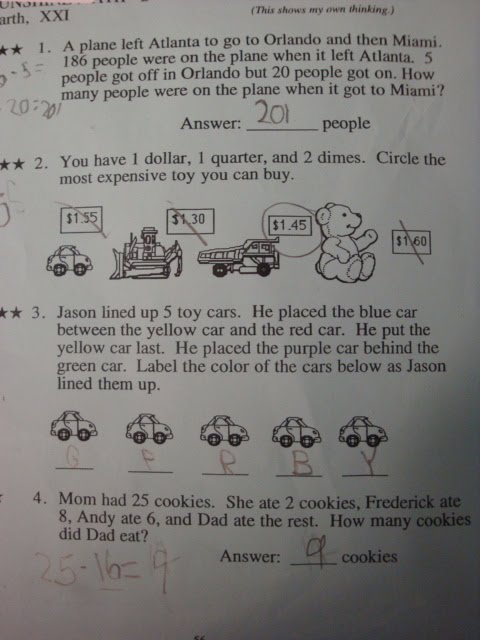
My youngest son is a Second Grade student at Chets Creek Elementary and is being raised in a math learning community that values young mathematicians and works hard to develop their number sense. Since Kindergarten, his learning hasn't consisted of rote procedures and memorization, rather his teachers have cultivated his number sense, stretched him to solve problems using a variety of strategies, and embedded problem solving.

Today, coming home from school, he pulled out his Sunshine Math sheet and got to work. (The Sunshine Math program is run by our PTA and is an optional program that students can sign up for at the beginning of the school year. The weekly sheets offer math challenges for students to complete independently. Students get the sheets on Mondays and turn them in to the PTA on Fridays. PTA volunteers correct the sheets and return them to students. Students are rewarded periodically by PTA for their participation and at the end of the year, the teachers host a Math Challenge Day for students to compete.) Most of the time, the questions are rich contextually based problems which promote my child's problem solving skills. However, today, on the back of the sheet, there were a set of problems that looked very traditional.

The problems themselves didn't give me angst, rather the way the traditional problem pigeon holed my child into solving using a particular strategy-the traditional regrouping algorithm. Notice problem d. Now, humor me, if you will, and write this problem down on a sheet of paper. Then, solve it.

Most of you, like me, probably solved this problem using the traditional algorithm and got the answer easily.

Now, take a few moments to consider how my son solved it.

At quick glance, you may, like the volunteer that will use an answer key to score my son's paper, mark his answer incorrect. However, if you take a closer look, you will see that he is correct. He gave the answer 17 because he did not use the traditional regrouping algorithm, and he did not adhere to the confines of the boxes. He looked at this problem and said, "Six take away nine is negative 3." You can see where he recorded the -3 in the box. Then, he said, "Fifty take away what will give me 20? That must be 30." He recorded the 3 in the tens place box. Next he said, "Twenty take away three is seventeen." He did this all in a matter of seconds and then double checked his work to prove that 56-39=17.

Since I knew that they wanted him to get the answer 27, and I was intrigued by his thinking, I wrote the problem 56-29 on a sticky note and asked him to solve. A second later, he handed me back the correct answer of 27. I said, "Tell me how you solved it." He replied, "I know 50-20 is 30 and 6-9 is negative 3, so the equation is 30-3 which equals 27." He used a left to right strategy to solve and is very comfortable with negative numbers. I said, "How did you know 6-9 is negative 3?" He said, "Do you want me to prove it to you on a number line?" He's eight years old!

I was very intrigued the moment I saw what he'd done with this problem on our car ride home. I've been an intermediate math teacher; I've been a math coach; I've worked as a math consultant. And, I've seen far too many math practice books, websites, and even state adopted textbooks that have this type of problem in them. They look harmless enough, but for kids who think mathematically and even for those in the process of developing their number sense, they can be detrimental.
I am thankful that my son has not had teachers who teach him to solve problems procedurally using only the traditional algorithm. He's been blessed to have an incredibly talented set of teachers that offer instruction to cultivate a students' mathematical thinking. Because of Mrs. Mallon, Mrs. Dillard, Mrs. Ross, and Miss Russell, Carter is a mathematician.

Sunday, March 28, 2010

Resource Teacher Meeting

Have you ever sat in a professional development session when you've thought-- This is a total waste of my time? This doesn't come close to meeting my needs for my content area? I know if you ask any teacher, most will give a resounding, "Yes!" to this question. I shutter, as a coach, to think that anyone feels this way, particularly anyone in my building. But, nevertheless, I know it happens, at least on occasion.

Many of our Professional Development opportunities at Chets are tailored to meet the specific needs of a grade level or content area. We have daily common planning time, weekly Teacher Meetings, and TDE days (Teacher Duty Elsewhere) where we offer relevant grade level / content area professional development to our classroom teachers.

In addition, there are times when it is necessary for the whole school to come together to learn and grow as a school community. Bi-monthly Early Release sessions and monthly Book of the Month are two such sessions. Most of the time, these sessions focus on data or reading which can be generalized across grade levels and content areas. However, often this year, I've wondered if our Resource (Art, Music, Physical Education, Media, and Character Education) teachers feel like they are getting useful training. Unlike classroom teachers, they don't get common planning time or weekly Teacher Meetings. They only receive the PD offered to the whole school, and unless we cover a topic they can adapt to their content area, I'm quite certain they don't get what they need.

We have a talented group of resource teachers who take charge of their own learning and seek opportunities outside our building, but it still left me wondering what I, as the Instructional Coach of the school, could do to help support their learning. I don't know much about their content areas, so my thoughts kept coming back to what I do know-standards and classroom instruction. Just like classroom teachers, they too have state standards designed to drive their instruction, but quite frankly, I had no idea if they were using them with great expertise, or not at all. I had no idea if everyone even knew how to access them on the state website, or whether they knew that all the state standards were being rewritten. I had no idea if they created and followed yearly pacing guides to be sure all content was covered, or not.

So, our first Resource Teacher Meeting was born. I began with a quick response sheet that would allow the Resource Teachers to reflect on their practice and share information with me about where they were on the journey of standards based education. I asked, "How often do you see each classroom of students?" "How do you plan for your lessons?" "How do you pace your content throughout the year?" "Which standards do you cover at each grade level?" "Are you able, given the time you have each student, to cover all of the standards?" The conversation was enlightening, and I now more fully understand why each resource teacher feels an urgency to meet with students as often as they can.
Our session lasted about 75 minutes and we discussed Florida's New Generation Standards and implications to their lesson planning and delivery; We talked about yearly pacing guides and how they might create one; We looked at the Standards/Curriculum/Instruction/Assessment Alignment and I shared the Workshop Model with them. Then, we reflected together.

I feel good about our session together. I want them to know that I value their craft and care about their learning. I have no idea how I'll continue to offer them support, but I know that I want to try.

Monday, March 15, 2010

Geometric Thought in Elementary School

Geometry is a part of our curriculum in Kindergarten through Fifth Grade. In Kindergarten, one of the standards reads, The student describes shapes and space, and uses basic shapes, spatial reasoning, and manipulatives to model objects in the environment and to construct more complex shapes and in Fifth Grade two of the standards read, The student describes draws, identifies, and analyzes two- and three-dimensional shapes and The student uses appropriate geometric vocabulary to describe properties and attributes of two- and three- dimensional figures (Example: obtuse & acute angles, equilateral, scalene, & isosceles triangles).

As children's' understanding of Geometry develops in elementary school, they move through three of van Hiele's five levels of Geometric Thought (Van de Walle, Teaching Student-Centered Mathematics). Visualization, Level 0, is when students recognize a shape based on its appearance. At this stage, students recognize a rectangle because it looks like a rectangle. As a student's knowledge develops and they move into Level 1, Analysis, they are able to understand classes of shapes. They don't just recognize a rectangle on its appearance, but are able to say it is a rectangle because it has four sides, four right angles, and opposite sides are parallel. Knowing the properties of the shapes gives the shape its name. When students move into Informal Deduction, Level 2, they are able to see the relationships and connections among the properties of a class of shapes. They would be able to conclude that a square is a type of rhombus because rhombi are polygons with four equal sides and opposite sides are parallel and congruent. A square fits this definition, therefore a square is a type of rhombus. Students in elementary school work through these stages, and then move into Level 3, Deduction, and Level 4, Rigor, later in their school career.

For our March Standard Snapshot, Kindergarten and Fifth Grade teachers used work from their Geometry unit to share with parents. The Kindergarten students were in the beginning of their unit and the Fifth Grade students were in the middle of their unit.

Kindergarten Student Sample


You will notice in this Kindergarten sample that the student has mastered Level 0, Visualization, because they are able to name the shape, a rhombus, based on its appearance. They have not proven, through this assignment, that they have mastered the Kindergarten standard The student describes shapes, and uses basic shapes, spatial reasoning, and manipulatives to model objects in the environment and to construct more complex shapes. The sample shows the naming of the basic shape and the model object, "a braslit," but the student has not described why the shape is a rhombus. To see if the student has developed understanding of Level 1, Analysis, the student would have to know that the shape is a rhombus because it is a four sided shape (a quadrilateral) with 2 pairs of parallel sides and four equal sides. This level of understanding is not expected of a Florida student until Grade 3.

By Fifth Grade, students are expected to move into Level 2, Deduction, where they identify the shapes within a class, but also can see the relationships between and among the properties.

(Click on the work to make it larger.)

Fifth Grade Student Work

Questions on the Student Sheet:

1. A square is a kind of rhombus. How can this be?

2. Name all the shapes above that are parallelograms. How can they be parallelograms and have other names as well?

3. An equilateral triangle is isosceles. How can this be?

4. Some obtuse triangles are scalene. Some obtuse triangles are isosceles. Sketch one or two examples of each.

5. Obtuse triangles cannot be equilateral. Explain why this is true.

This Fifth Grade assignment, Some Shapes Fit Many Categories, asks questions to assess students' geometric thought. Students who master this assignment are able to identify, draw, and analyze shapes, and are able to make connections about the relationships among their properties. They have moved into Level 2 of Geometric Thought. Students who have not yet mastered the assignment are likely at Level 1 of Geometric Thought, Analysis. After the teacher analyzes the student work he/she will be able to assess which students need more exploration with the concept through small group instruction.

When the Standard Snapshots were turned in, I was intrigued to see that both Kindergarten and Fifth Grade were sending home work in Geometry. It got me thinking about where students begin their geometry journey and where we expect them to be when they leave elementary school. It also got me thinking about the process that occurs for that learning, and the key role that each teacher plays with instructional delivery along the way. In addition, it made me go back into the standards to explore the vertical alignment from K-5. I came across a document that aligns the comparisons and is an easy to read resource for teachers. They are able, through this one document, to see what students learned previously and what students must be able to master during instruction in their classroom. It reaffirmed for me the importance of each piece of the puzzle in their journey, so students master the necessary skills and concepts before they emerge as middle schoolers.

Standard Snapshots of Student Work

At Chets Creek, our central focus has always been on students' academic performance. The work students produce lets us know whether our targeted instruction has worked or whether we need to reassess our path. When you stroll through our hallways, you see student work aligned with standards on each teacher's bulletin board. We post the work so our colleagues can compare work across grade levels or content areas, parents can see work that meets the standard, and students are exposed to the level of work they are expected to produce. The student work makes our classroom instruction more transparent and visible.

In addition, at weekly Teacher Meetings, it is not uncommon for teachers to bring student work to analyze. Their collegial conversation about the instruction that led to the students' products often has them exchanging valuable instructional ideas.

Years ago, in an effort to educate all of our parents, even those that are unable to stroll through our halls, we decided to package our standards-based bulletin board in a handout to be sent home with each student. The Standard Snapshot, as we called it, would be produced by each grade level and content area to go home with our students. In addition, to the selected grade level piece that is copied on the back of the handout, we also staple their own child's work on the assignment.
To prepare for a Standard Snapshot, each grade level / content area team meets to discuss work that is currently being produced. They agree upon a common assignment and they collect all students' work from the task. The teachers meet to review, compare, and select the student sample. They select work that meets the standard rather than work that exceeds the standard, because we want to educate parents about what their child's work is expected to look like. After the Snapshots are written, teachers turn them in to me with the original piece of student work; I edit / revise them, and turn them in for copies. After copies are made, the teacher attaches each child's work to the Standard Snapshot, and sends them home with students.

Creating a Standard Snapshot has been a parent communication piece for the past eight years, and is a powerful venue for collegial dialogue about student work among our teachers. It is a collegial practice that focuses on students' work products as they relate to the standards and is a practice I continue to find valuable and informative.

Second Grade Science Standard Snapshot

(To enlarge, click on the picture.)


Second Grade Student Work Sample Printed on the Back of the Snapshot


My Child's Work That Was Attached to the Snapshot

Tuesday, March 2, 2010

March Math Council

"Assessment should be the servant of teaching and learning. Without information about their students’ skills, understanding, and individual approaches to mathematics, teachers have nothing to guide their work.” Mokros, Russell, and Econompoulous


To guide our prescriptive teaching for students and to track students' learning, Chets Creek, from its inception, has given a diagnostic assessment in mathematics. Before the doors opened in 1998, the founding principal, Terri Stahlman, assembled a team of teachers to write a summative assessment, a final exam if you will, covering the state standards in Mathematics, designed to be given three times a year--at the beginning, middle, and end of the year. This diagnostic in mathematics has continued to be a cornerstone of our work. In addition, over the years, it has also become a predictive instrument for how students will score on our state standardized testing.


The beginning assessment allows our teachers to get a baseline of student's knowledge upon entering a grade level, and gives teachers aligned data to build class plans of instruction. We set 80% as the cut off. If 80% of the students master a skill/concept, then the teacher doesn't spend time on the whole group instruction. To meet the needs of the 20% or fewer, she uses small group instruction to teach the concepts and skills not yet mastered. If fewer than 80% of students mastered the skill/concept, the teacher plans and implements instruction for the whole group.

At mid-year the teacher gives the same assessment. She analyzes the results to ensure that students are retaining information. She builds class plans for whole group and small group instruction. She is able to track student's progress to share strengths and weaknesses with a parent. In addition, the teacher is able to compare her data to her colleagues and share best practices in instruction. We also have the added bonus, because we've aligned the diagnostics with our state standardized scores, to predict how well we will perform on our FCAT assessment given three months after mid-year administration.

The end of the year assessment is given to prove that each student has mastered at least 80% of the content and has the proper foundation for moving into the next grade level. We do not use the information as a retention tool, rather just as information for the parent and the school.


Each step of this assessment is given to inform teaching and learning. But, we know, the data gathered from the assessment is only as good as the assessment itself. For the assessment to serve each of these purposes, it must be aligned with our state standards, curriculum, and instruction. For us, looking into next year, this is where the issue lies. Our state has rewritten and adopted new math standards, and the math state standardized assessment will reflect the changes. To compound the issue, our district is also in the process of adopting a new math curriculum. Therefore, our instruction and our assessment must be altered to reflect these changes. This was the topic of our Math Council last week.

Each math lead was charged with cross referencing their current math diagnostic assessment with the New Generation Standards to figure out how much work needed done on the assessment to align it. Then, the leads will work in teams on a TDE day to keep the assessment questions that align with the new standards, throw out the questions that are no longer covered, and write questions for standards that have been added. Of course the writing of the assessment is only the beginning. After that, answer keys will need to be created, individual student profiles will need to be developed, and EXCEL spreadsheets will need to be reworked. I know we will only scratch the surface in the TDE day, but at least it is a start in the right direction. Though this is a mountain of work, we know that it is necessary, and we must have it in place for the 2010-2011 school year. It won't be easy so wish us luck on the way.

The term assessment is defined in the Assessment Standards as “the process” of gathering evidence about a student’s knowledge of, ability to use, and disposition toward mathematics and of making inferences from that evidence for a variety of purposes.” (NCTM, 1995, p. 3)