Thursday, November 8, 2012

Density Gizmo

 This week, with a Density Gizmo in Science, our students continued to deepening their understanding of matter, mass, and volume, and explored density. They first brainstormed objects that they think would sink in water and then those that would float, and formed a hypothesis for why the objects sink or float.

After that, they did a Gizmo warm-up which familiarized them with the virtual exploration by measuring the mass of objects on a scale, and measuring the volume of objects using water displacement in a graduated cylinder.    

The essential question then focused their activity, How do mass and volume affect sinking and floating?  


During the Gizmo, students filled in a chart with each object's mass and volume, and then whether the object would sink or float when placed in the beaker.  This is a sample of their chart.


Object
Prediction
(sink or float?)
Mass
Volume
Result
(sink or float?)
Ping pong ball
F
3.0 g
36.0 mL
Float
Golf ball
S
45.0 g
36.0 mL
Sink
Apple
F
33.0 g
44.0 mL
Float
Chess piece
S
40.0 g
80.0 mL
Float
Penny
S
3.0 g
0.4 mL
Sink
Rock
S
200.0 g
50.0 mL
Sink

They analyzed their results and concluded that you could not predict whether an object would sink or float using the mass alone, because the mass of a ping pong ball and penny were both 3 grams and one floated while the other sank. Based on the volume alone, they concluded that you could not predict whether an object would float or sink, because the volume of a ping pong ball and golf ball were both 36 mL and one floated while the other sank.

However, mass and volume, when considered together could predict whether an object would sink or float. When an object's mass was less than the object's volume, the object floated.  When an object's mass was more than an objects volume, then the object would sink. Density refers to the mass found in a given volume of a substance. 

These are third graders that I teach and they are taking it in like sponges! They even clapped when we said, "Today, we will be doing a Density Gizmo!" It doesn't get any better than that!
 

Decomposing Arrays and Multiples of Ten

Our students' knowledge of multiplication has come so far in so little time. We worked on finding the total number of squares (or area) in an array. An array is a multiplication model used to work toward independence and mental math strategies. 

Students discovered that by decomposing the array into smaller arrays, they could more easily find the product. We also encouraged them to record using correct algebraic notation. You'll notice in this piece of student work that 4 x 3, said, "four groups of three," can be decomposed into (2 x 3) + (2x3) = 12.


More recently, we've been exploring larger numbers, too, and recognizing relationships. The chart below was created by my co-teach partner, Ashley, during a lesson to emphasis why students have been seeing the pattern of a 0 in the ones place. Zeros aren't merely added to the ones place, rather they are in the ones place because they are a multiple of 10. Multiples of 10 have a 0 in the ones place. A student could see that 5 x 60 = 5 x 6 x 10. This helps them see why the pattern occurs.

Monday, October 29, 2012

How is the Mass and Volume of Matter Measured?


Today our young scientists participated in a science lab to answer the essential question, How can mass and volume be measured? 

To get started,  students had to make a hypothesis about which has more mass a crayon or a pencil. Then, using a pan balance with gram weights, they had to measure the mass of each. 


After that, they made a hypothesis on whether a marble or a seashell had more mass, and then measured the mass of each. (When the groups analyze their data, they will realize that the mass of all the marbles in the class are the same, however the mass of the seashell changes. The smaller the seashell the less the mass, the bigger the seashell, the larger the mass.)

Furthermore, students made a prediction about the volume of two cups of liquid, and then used a graduated cylinder to measure each volume.  (The red liquid was in a tall narrow glass and the blue liquid was in a small wide glass. Each contained 150 mL of colored water.)


Students were surprised to discover that they could also find the volume of a solid. An object's volume is the amount of space the object takes up. To find the volume of a solid, like the marble and the seashell, students used water displacement. They put 100 mL of water in a graduated cylinder, then gently dropped the solid in the water. The volume is recorded by the number of mL of water that was displaced, or moved. 

Tomorrow, we will have Closing Session where students will have to compare and then explain their results. By the end of Science Workshop tomorrow, students will be able to tell how the mass of matter is measured, and how the volume of a solid and liquid is measured.

Multiplication Strategies

Young mathematicians’ first formal introduction to multiplication and division happens in 3rd Grade.

In our unit, Equal Groups, situations are presented in context. The situation usually requires students to identify the number of groups and the number of items within each group.

There are 5 tricycles. Each tricycle has three wheels. How many wheels are there in all?

Or, the situation may read,

Tricycles have three wheels. There are 5 tricycles. How many wheels are there in all?

Number of Groups: 5
Number of Items in Each Group: 3

Students are taught to represent the problem with both an addition equation and a multiplication equation to illustrate the connection, and use a variable for the missing piece of information.

Addition equation: 3+3+3+3+3=w
Multiplication equation: 5x3=w (read 5 groups of 3)

Students generally begin solving the multiplication situations with their prior knowledge of repeated addition.

Repeated Addition: 3+3+3=9 and 3+3=6, so 9+6=15.

Then, some students move into skip counting if they can easily skip count by that number. If the situation allows counting skip counting by 2’s, 5’s, and 10’s, students will almost always start with this strategy. If however, the situation has them skip counting by 8’s, then we’ll teach students to use 10 as their anchor. Skip count by 10 and go back 2.

Skip Counting: 3,6,9,12,15.

One tool that we teach students to use to organize their thinking when skip counting is a ratio table. Ratio tables help students keep track of the number of groups as they skip count.


During the unit, students are introduced to multiplication situations using arrays, too. An array is a rectangular arrangement with rows and columns.


To create a common language with our students, we have them give us the dimensions of the row first and then the column. The array above would be a 5x3.

There are many ways to solve the array. One of the things students do is skip count the array.
They can skip count the array be either the rows or columns.

Students naturally begin to see and explore the commutative property of multiplication. Though the situation is 5x3, they realize they can applying their number knowledge properties, and solve 3x5 instead (5,10,15 or 5+5+5=15).

Students’ next level of understanding develops when they recognize that they can decompose an array into smaller arrays to help them solve problems.

In this situation, if a student didn’t know the product of 5x3 quickly, they could decompose the array into (5x2) + (5x1) = 15.

This understanding is extremely important as students move into problems that are more difficult when they begin multiplication like 6x8. When in the early stages of developing automaticity, they may not know 6x8, but if they know (3x8), they can solve 2(3x8), or, if they know 6x4, they can solve 2(6x4).

Students’ ability to think flexibly with decomposing arrays in multiple ways, builds a strong foundation for fluency in multiplication. The skill allows students to attack any multiplication equation for which they don’t automatically have a product, and leads into being able to solve more difficult equations like 14 x 12.

After the unit, Equal Groups, students have a solid conceptual foundation and can think about multiplication flexibly. But, if we stop there, they may never become fully fluent. We continue to practice fact fluency with our combination club flash cards, by playing multiplication bingo, doing fluency clicker reviews, and doing a timed fluency snapshot several times a week. The fluency snapshots are presented by similar facts. (5’s and 10’s together) (2’s and 4’s and 8’s together) (3’s, 6’s, 9’s, 12’s together) (7’s) and (11’s). Presentation with similar facts promotes the conceptual understanding we build throughout this unit.

Our goal is for every student to leave third grade knowing each of their multiplication facts within three seconds. This foundational knowledge creates automaticity and will help them be successful in fourth grade as they embark on more complex multiplication problems like 49 x 58.

Decomposing Arrays

In our multiplication unit, students have been using an array model to help them visualize the organization of things in equal rows. We worked on finding the total number of squares (or area) in an array.  The following is the work that students completed during the math workshop.
An array is a model for multiplication (and eventually division too). The goal is for kids to transfer this thinking to multiplication equations using mental math, without an array present. For example, a student might solve 8x6 as (4x6) + (4x6) or (8x3) + (8x3). They will learn to record it as 2(4x6) and 2(8x3).

Multiple Charts for Multiplication

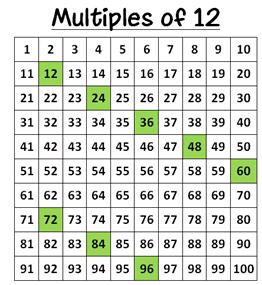
 As we moved further in our multiplication study, we began examining multiples charts. We have highlighted multiples of all numbers 2-12 and have found the patterns that exist between certain charts. For example, we recognized that the multiples of 6 are also multiples of 3 and that there are twice as many multiples of 3 as there are of 6. We also discovered that we skip count by an odd, even, odd pattern. We also discovered relationships between 3s,6s, and 12s.  Furthermore, students pointed out that 100 is not a multiple of 3,6, or 12. In addition, we began answering questions like, How many 3s are in 30? How many 3s are in 60?


We strategically place the students' multiple charts in their packets so they can make connections and find relationships. Below is an example of the work that students completed in class as part of their multiples study.  You will notice that the 2s, 4s, and 8s charts are all on the same page. On the next page are 3,6, and 12. 5s, 10s, and 20s are together, too. In addition, we place a 9s and 11s together and talk about their relationship to the landmark number 10.

Wednesday, October 10, 2012

Things That Come in Groups

In Room 207, our third grade mathematicians are excited to have embarked on a new journey in multiplication. On the first day, as part of their Work Session, students brainstormed a list of things that come in groups. In Closing, we made an anchor chart that will hang during the unit as a reference.


During this unit, we emphasize that we are finding "groups of" items. For example, There are 4 tricycles. There are 3 wheels on each tricycle. How many wheels are there in all?  Students would write 4 x 3 = 12  and say, "4 groups of 3 equals 12 wheels."   We expect this language so students keep the conceptual understanding that they are finding groups of items. 

On the second day, students created pictures of things that come in groups. The task required students to choose an item and draw several groups of the item. Then, they had to write a sentence about the three pieces of mathematical information in their picture. They were asked to include an addition and multiplication equation, too.   I've included several student samples below.


Even though we are only a few days into our multiplication unit, students are uncovering multiple strategies for solving their problems. Our anchor chart lists some of our strategies so far. Stay tuned for more to come, we'll be adding more strategies as next week unfolds.